


Podcast Summary
What happens when the career that defined you ends? You rewire life! For many people, retirement, an unexpected job loss, or a major life transition raises a much deeper question than “What’s next?” What they don’t know is how to “rewire” their lives.
It asks, “Who am I now?”
In this episode of On the Brink, I welcome Leslie Traub, transformational facilitator, executive coach, and founder of Rewiring Together, for an inspiring conversation about identity, reinvention, and navigating life’s “liminal spaces”—those uncertain periods between who we were and who we are becoming.
After spending more than forty years helping organizations and leaders manage change, Leslie found herself facing the same questions many of her clients encounter after selling her own consulting business. Rather than simply filling her calendar with activities, she began exploring the deeper psychological and spiritual dimensions of transition.
That personal journey became the foundation for her work helping women over fifty rediscover purpose, confidence, and joy.
Retirement Is Not the Challenge—Identity Is
One of the themes Leslie returns to throughout our conversation is that most people are not afraid of retirement itself.
They are afraid of losing the identity that work provided.
Titles disappear.
Responsibilities change.
The external validation that once measured success suddenly becomes quiet.
Many people instinctively try to replace that identity by staying busy. Leslie shares a powerful story of meeting a woman whose calendar was overflowing—not because she loved the activities, but because she believed she needed constant achievement to prove she still mattered.
That realization became the catalyst for Leslie’s work today.
Rewire Life: Learning to Live in the Liminal Space
As an anthropologist, I often remind clients that humans dislike uncertainty.
We want clear beginnings and endings.
Life, however, rarely works that way.
Leslie introduces listeners to the concept of liminal space—the uncomfortable but incredibly creative period between an old identity and a new one.
Rather than rushing to eliminate uncertainty, she encourages people to stay with it.
When we stop trying to recreate the past, we create room for an entirely different future to emerge.
From External Success to Inner Purpose
One of the most thought-provoking moments in our conversation explores the transition from living for external achievement to living from internal purpose.
Early in life we often build careers, accumulate accomplishments, earn promotions, and collect recognition.
Those are important milestones.
But eventually many people discover that achievement alone is no longer enough.
Leslie believes the second half of life invites us to shift from proving our worth to simply living it.
Purpose becomes less about titles and more about contribution, relationships, creativity, wisdom, and authenticity.
Why Women Face Unique Challenges When They Rewire?
Leslie also discusses the particular pressures many women experience throughout their careers.
Conditioned to care for others, prove themselves, and continually give more, many women reach midlife emotionally depleted.
She encourages women to establish healthier boundaries, reconnect with their own values, and stop measuring themselves solely through external expectations.
The result is not withdrawal from meaningful work.
Instead, it is work that aligns more closely with who they truly are.
My Reflections on How to Rewrite Life
One of the reasons I enjoyed this conversation so much is that it reinforces something I continue to see in my work around Rethink Retirement.
The greatest transition is rarely financial.
It is emotional.
Whether someone retires voluntarily, sells a business, loses a job unexpectedly, or simply reaches a point where life begins asking new questions, the challenge becomes learning to write a new story.
As Leslie reminds us, uncertainty isn’t something to fear.
It is often the doorway to discovering who we are becoming.
If you’re standing at one of life’s crossroads—or helping someone else navigate theirs—I think you’ll find this conversation both comforting and inspiring.
Sometimes the next chapter begins not by having all the answers, but by becoming willing to ask better questions.
I hope you’ll listen.
Listen to the Episode
If this conversation resonates with you, please subscribe to On the Brink with Andi Simon, leave a review, and share this episode with someone navigating an important life transition.
Together we can continue to see, feel, and think in new ways.
To connect with Leslie Traub:
Leslie’s profile: linkedin.com/in/leslie-traub-b01a684
Website: leslietraubart.com (Personal) and udarta.com (Company)
Connect with me:
- Join my Substack Newsletter Rethink Retirement
- Website: www.simonassociates.net
- Book Website: www.andisimon.com
- Email: info@simonassociates.net
- Learn more about our books here:
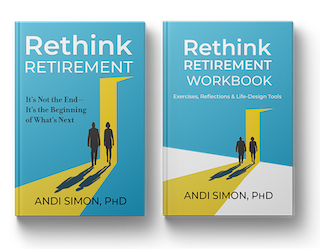
Now–it is time to share our new book with you!
Rethink Retirement: It’s Not The End–It’s the Beginning of What’s Next
Out on Amazon and WalMart, and in your local bookseller and Rethink Retirement: The Workbook
Continue the Conversation
What does retirement mean to you?
I’d love to hear your thoughts. Share your experiences in the comments or join one of my upcoming Rethink Retirementworkshops where we explore the questions that matter most—not just about your finances, but about the life you want to create.
Listen + Subscribe:
Available wherever you get your podcasts—Apple, Spotify, Stitcher, YouTube, and more. If you enjoyed this episode, leave a review and share with someone navigating their own leadership journey.
From Observation to Innovation,
CEO | Corporate Anthropologist | Author
Simonassociates.net
Info@simonassociates.net
@simonandi
LinkedIn
About the Host
Dr. Andi Simon is a corporate anthropologist, keynote speaker, consultant, and founder of Simon Associates Management Consultants. Through anthropology, she helps leaders and organizations understand how people think, why they resist change, and how to create cultures where innovation can flourish.
She is the host of On the Brink, one of the world’s leading podcasts on change and innovation, and the author of several books, including Rethink: Smashing the Myths of Women in Business; Rethink Retirement:It’s not the end but the beginning of what’s next; Women Mean Business,; and On the Brink: A Fresh Lens to Take Your Business to New Heights.
Her mission is simple:
Help people see, feel, and think in new ways so they can adapt and thrive in a changing world.
Learn More
🌐 SimonAssociates.net
📚 Explore Andi’s books, workshops, and speaking programs.
🎙️ Subscribe to On the Brink with Andi Simon wherever you enjoy podcasts.
If you enjoyed this episode, please follow the show and leave a review. Your support helps more people discover conversations that inspire fresh thinking.
Check out the entire text here:
[00:00:00] Andi: Welcome to On the Brink with Andy Simon. I’m Andy, and you know my job is to get you off the brink. Sometimes I want to change the introduction to this podcast, but at the end of the day, that’s my job. My job is to bring you interesting people with great stories who are going to help you really see, feel, and think in new ways, cause that’s what an anthropologist does.
I want you to become a little bit more m- observant. Look out at what’s going on instead of being inside and be certain about what you’re doing is the way to do it. Maybe there are other ways you can do it Today I have a wonderful woman here with us, Leslie Traub, who’s going to begin to share with you her own journey.
We’re going to focus on rethinking retirement, because as we’ve moved into this new area, I’m just fascinated by how many different ways people are really trying to build the next stage, next chapter, call it what you wish. Someone said, “Do I have to call it retirement?” I said, “You can call it anything you like.”
But how do I really take charge of the first time in my life where I am in charge? And so I’m enjoying sharing this. Now I want to thank you upfront. You have made us number 18 among the top 100 podcasts on the topic of change. We’re among the top 20 on the futurist. I’m not sure this is futurism at its best or its worst, but it is about the most important part of your life, where you’re going to be in charge of what happens next.
Leslie, thank you for joining me today.
[00:01:30] Leslie: Thank you for having me, Andy, and one of the things I love about what you just said in your introduction is how we might be less certain about how we move forward because we’re so conditioned to think and be in a particular way that when we get to the big moments in our lives, if we can loosen our attachment to the way we used to do things, we’ll have much more chance of falling into something that is more aligned with our soul’s journey rather than the way we’ve always done things.
[00:02:05] Andi: Let me give you a little bio for Leslie, and then I’ll tell you about her story. bios are always good to set the stage. Leslie Traub is a transformational facilitator, a coach, and a thought leader who spent more than four decades helping people navigate change, growth, and reinvention.
So it’s going to be an interesting conversation today. We’re right up her alley. Throughout her distinguished career in organizational development, leadership, and inclusion, she’s worked with Fortune 100 companies, universities, and global organizations. Now she loves to guide individuals and teams through some of life’s important transitions.
She’s actually written an article on this liminal space, and I talk often about it, but few people know what that means. Today, Leslie’s best known for her pioneering work with women over 50. Now, she and I are both over 50, but, mm, it’s interesting to think about us as over 50. She has an organization called Rewiring Together, and she really does think of this as a rewiring.
She helps women explore the psychological, social, and spiritual dimensions of aging, retirement, and life’s next chapter Drawing upon decades of study and personal development, Buddhist teachings, Jungian psychology, and group process facilitation, she creates powerful experiences. One that’s coming, actually it’s going to be by the time I post this, it will always have happened at Omega, but we’ll talk a little bit about what this life experience is like.
What makes her work especially compelling is it grows from her own journey, which is now what I’m going to talk about. After exiting her business at age 58, she found herself confronting many of the same questions her clients face today. I’m not going to tell you much more. It’s much more fun to let you listen to Leslie tell you about her own journey.
So Leslie, your turn. Mm, who’s Leslie, and what brings you here? And how do we begin to now help others through their journey? It’s a great time. Leslie, please. Thank you so
[00:04:08] Leslie: much, Andy. That was a lovely introduction. I, I won’t repeat some of what you said other than bring you to the moment when we transitioned our business in 2018, and we had a 50-person global consultancy.
As you know, this is a, can be and is an all-consuming, full-on operation. I never thought about what was going to happen after the day we signed our sale papers. Ah.
[00:04:39] Andi: And I,
[00:04:41] Leslie: I just didn’t. We happened to have a great activity to move into. My brother, who lives in Asia, launched these leadership development programs for those who had made their millions in their mid-20s who hadn’t quite grown up into the fully aware adults.
[00:04:58] Andi: Uh-huh. Yeah,
[00:04:58] Leslie: and so that was engaging for a couple of years. We did those all over the world. And then after COVID, you know, I was really sitting with the question always, “What am I going to do? What am I going to do?” And I had an insight in ’21. I was at a place called Rancho La Puerta just over the border in Mexico.
talking to a woman I’d spent the week with about what are you going back to? This is a health spa, kind of a very holistic, lovely place. And she burst into tears, and she started naming all of the activities she was involved in, boards, PTAs, five or six things, and she was crying. And I asked her, “What is it that’s making you sad?”
They weren’t happy tears, you know? They were sad, frustration tears. I asked her why she was feeling the way she was feeling, and then why was she doing all this activity if it made her miserable. She said, “To show that I have value in the world.” Oh, my.
[00:05:57] Andi: Yes. Pause for a moment. she was doing all of this, made her unhappy, because she needed an echo, a mirror back, that she had value.
Yes. Purpose. Wow.
[00:06:07] Leslie: Please
[00:06:08] Andi: continue.
[00:06:09] Leslie: Yes. So what that did for me in that moment was, having supported women for decades in my career, and having heard this story before, I never wanted to hear another woman say she did things to show that she had value, like you said, to get that external validation. And I walked from that conversation in the mercado into, like, a creative writing workshop in which this workshop that I lead now was downloaded.
Wow. It just, it, you know, these wonderful exercises where you start writing the future in the present tense. Mm-hmm. Describing with all of your senses, and I didn’t know it was there. It was a gift from my unconscious, and that became the vehicle to bring this work into the world and invite women over 50 to really begin considering, A, our conditioning.
Mm-hmm. Which is why I loved your opening comment so much. B, our identity.
[00:07:15] Andi: Mm-hmm.
[00:07:16] Leslie: Which I know that listeners on this podcast are probably getting the reinforcement of every time, and how identity can trap us. And C, the trajectory that happens in our lives when we move from ego, the first part of our lives where we’re putting up the tent poles so that we know who we are, to soul, which is the essence of our being.
It’s, our purpose. It’s why we’re here. And rarely we’re lucky enough to have that be the thread through our lives. Mostly what I learned from women is that these years, these decades, become the pivot point for us to move from the external validation of the world, that next level, the salary, the titles, the boards, you know, all of the things that let us know from the outside who we are, to the internal satisfaction of just knowing that who I am is enough.
It’s a gift. It’s I’m there to bring whatever my gifts are to the world, even if your gifts go no further than your garden Wow.
[00:08:35] Andi: It’s, so it’s interesting, I spoke yesterday at a conference, a Women Mean Business conference. Yeah. And I was talking about m- m- the book I’d written called Women Mean Business, and one of the other speakers uses a hula hoop metaphor.
And I’m thinking about her as I’m listening to you, this transition from ego to the spirit and the soul, and she talks about being in the hula hoop where it’s going around, and around, and around with you, and you’re always focused on the outside- Mm-hmm … as opposed to what you can control on the inside looking out.
And one of the questions that came up was, what do I do with a mean boss, a woman boss? And it was an interesting conversation about so many things that women deal with. Mm-hmm. So I’m going to come back to you. I, I, I wanted to put that in their cause I have a hunch it’s a visual as you’re thinking about it, cause you’re helping folks look at the future by remembering it.
How did I get there, and what’s a visualization of it? And in the process, begin to understand who they are today as they begin to move forward. Can you tell us a little bit more about both the process and what you’re discovering about people, women, who are beginning to discover who they really are, not just the things they do, the tent poles they’re putting up- Yes
and the businesses and ac- achievements that they have? You know, they are at an interesting, important point inside that hula hoop, looking outside, trying to now make sense of it. Does that make sense?
[00:10:09] Leslie: It makes a lot of sense, particularly because the hula hoop stays in place when there’s tension in the body to keep it moving around.
Yeah. And one of the hallmarks of this time of life, over 50 women, is the ability to hold tension- Mm … without needing to resolve it. That which is a huge gift, and it’s actually I work a lot with the archetype of the queen. Mm-hmm. So in the Jungian world- Uh-huh … we use the queen archetype because most of us don’t really know, we don’t have a roadmap for what it is to be a fully sovereign woman.
And I don’t mean sovereignty with power over others; I mean sovereign on the inside. That, that we, that we fully claim ourselves, that we’re boundaries, which is really important at this time of life, and that we, we know how to resource ourselves instead of emptying our pot every day, that we find ways to fill it so that we’re not walking around on empty, which as you know, having been in the corporate world for as long as you do, is one of the greatest risks for women in the workplace.
And all of the autoimmune disease that comes from constantly emptying your pot and not knowing how to fill it. So I, I, I’m not sure if that, if that’s resonating with you.
[00:11:39] Andi: Well, it is, but I want you to explain it a little bit further. Give some illustration. I mean, I was an executive at multiple financial services places, and we worked our 12-hour days and, my kids occasionally reminded me I was a pretty good mother, even though I wasn’t necessarily thinking that way.
but the, the illustration of that feeling, I think is important to describe because, you know, you can hear you say you’re emptying it, but now you have some, you need some boundaries, and you need some ways of filling it, and doing it without feeling guilt.
[00:12:15] Leslie: Yeah, absolutely. That’s a, that’s a huge hurdle for women in the workplace because we tend to be very other focused, and I also believe that the prevalence of the imposter syndrome is much greater than is ever acknowledged.
Mm-hmm. And when we feel like we have to prove ourselves at work, we’re giving more and more than we need to, because it’s in some conversation that we’re not enough. And so whatever personal work we need to do, your listeners need to do to reconcile that not enough Ness, that’s when we have the moment when we have enough self-respect potentially to know that we need resourcing as much as we need to resource others.
And that resourcing comes from doing the personal development work, whether that looks like workshops or therapy or groups or just reading the books to really get clear on who you are and what your values are, and to make sure that you are in alignment With your purpose. And sometimes when women engage in this activity, then they then come to the realization that what they’re doing now does not serve who they actually are.
It serves some image of who the world thought they should be. Yes. But not who they are in essence. And I’ll give you a quick example with younger women. So there was a time when, I worked a lot with the big professional services firms, mostly the accounting firms, but also the consulting firms. And as you know, there’s a churn policy in place, right?
Let’s get the best and the brightest in here, let’s work them to the bone and see who rises to the top. And what I observed in these environments is that the young women, maybe 24, 25, 26, had been guided into these professions because mostly they were good at math.
[00:14:30] Andi: Uh-huh.
[00:14:30] Leslie: And that they were sold the carrot of income and prestige as something that was waiting for them down the road.
Mm-hmm. So I designed a program for them probably in the mid-’90s called Dynamic Choices for Women, in which we examined our values, our stories, and to try to discern the voice that’s in all of us that’s actually our true voice. Call that intuition or the feminine that is often overridden by the mind, which is usually about fear and control.
And I told the clients, “I’m going to do this work with you, and here’s what I think will happen. You will have some women that leave because this work is not in alignment with who they are, and you will have some women who come to you and ask you for some kind of accommodations so that they can have the lives that they envision while doing this work that excites them.
But because it’s so all-consuming, they won’t stay.” Mm-hmm. “If you want them to stay, then you’ll look at these accommodations that they’re requesting.” And so it’s not just women in our 50s and 60s. Mm-hmm. But the earlier we can introduce these notions of alignment to the workforce, we will have a healthier workforce, and women will be better boundaries and not as afraid, to ask for what it is that they might need in particular so that they’re successful and happy in those workplaces.
[00:16:07] Andi: You know, it’s interesting because you’re really describing the mythology that we are living In those women, I mean, I had an accounting firm for seven years as a client, and, mm, it took a long time before a woman became a partner. The women did o- many, much of the work. There were guys as well.
but it was a, A- and the pandemic was fascinating because they now could work out of the house and they could have a life. And when it was time to come back, they said, “No thanks. I’m not going to do that. I can have a life, and I also can be an accountant, or I can be a financial planner, and I don’t need to be fully devoted to you.”
“But we need you to come back.” “No, no, no, you don’t need us to come back. You want us to, but that’s not what we- is needed.” but you’re, you’re raising some interesting mythological points here, and part of the book Rethink Retirement is about the myths that we hold up to be true. Mm. And this becomes part of the way we control people, part of the way society sets values and, deliverables.
but we live mythical lives. They’re not real. I tell people there’s no reality. The only truth is there’s no truth. but you’re, you’re living through something, and when you look at it at the 50s, not necessarily at the 60s or the 70s, we’re all through different stages as we are moving. Humans don’t like transitions.
They are very much black and white. The purples and the blues, you know, between… The, the, the grays are very human unsettling. Yes. but, you know, things happen in, in really important ways. And your article on the liminal phases I thought was a very important and interesting one. and I’d like to begin to focus on it a little bit if you don’t mind because I think it’s important to help people understand that all of their life, 20s to 30s, 30s to 40s, you know, you want to think of them as decades, go ahead.
But all of it is a matter of transitioning. Yes. And I often talk about when you’re a kid, they want to know what do you want to be when you grow up? And when you get into school, they want to know what do you want to study? And when you get into college, what are you going to major in? Right? And then you get out and you get a job, and to your point, it’s not necessarily who you are, it’s how you find a job, and others are often defining you.
“You’re good at math, you should be an accountant.” And so now the question is how do we go through these transitions whole? And you said from the ego when we’re building the tent to the spirit and the soul when we’re becoming who we are. It’s a wonderful way of thinking about, mm, these phases. How do you help people go through them and understand them, so they don’t fight them?
Because often they, they’re in denial. “I don’t want to do it. Do I have to?”
[00:18:49] Leslie: Please. Yeah. For sure. That, that’s a really great question. I would say most of the women who come through my workshops are in liminal space, and they’re very uncomfortable, as you said, because we don’t like change, we don’t like the unknown, and- One of the things that I work with them on is learning to be, to be able to hold the tension of knowing that there’s something in front of me and not knowing what it is.
Mm-hmm. And to allow that time to be more of a creative exploration than fear-based. Because when we’re in the middle of a transition, especially around employment, then our fear kicks in and has us make decisions that are not always right for us. And if we have the luxury, and, and I do want to make a note here that not everybody has the luxury of time in these transitions.
Mm-hmm. So it is a privilege to have time, and even if, you know… I mean, right now the job market is just very difficult, and in the world of consulting, contractors, organization development, diversity equity inclusion, leadership development, that whole world has really been pummeled post-COVID and post all of the, the, the, I don’t know what to call it.
I want to say bloodletting from the federal government that had all of these reverberations throughout our system in terms of losing opportunity. So when you’re in that kind of space and you’re in your 50s, you know, women… Let’s just talk about the federal government for a minute, and I’ll get back to liminal space.
because the federal government has been a space of where they’ve prioritized equity, civil rights, and really, really practiced, really worked hard to practice, equitable talent management, you have a lot of women and people of color who are at the highest levels of the federal government, and they of course were the target for the reduction, let’s call it not bloodletting, but reduction in force.
And so I’ve had a lot of women at the top of their careers in their mid-50s running massive departments for the federal government have their careers pulled out from under them. Yes. And when you’re 55 and 58 and 63, the job market is not such a friendly place. Mm-hmm. And ageism is absolutely alive and well, and combined with sexism makes these transitions, particularly for women, particularly difficult.
And so if I can help them sit with the tension- evaluate their circumstances to see whether they need to work tomorrow or they have time, and then to remove that stress- Mm … from the moment of holding the tension, and to give them an experience of creative sitting, if you will, with that tension, and learning to turn towards their intuitive voice, overriding the voice of the mind to listen to the, their, their inner guidance.
Mm. And to actually have an experience of that They begin to relax. And I, that is something I can deliver in, in the course of that workshop. I deliver that moment, then it’s up to them to know that they can breathe, that they can do whatever sort of in- personal inquiry work is called for from them.
Whether it’s journaling or workshops or, you know, all the things I mentioned before, you know, in the Jungian world, active imagination, looking at your dreams, things like that, to allow this to bubble up. Then their inner authority is more grounded. Mm-hmm. They’re not looking so much for the external validation, but they’re trusting themselves to move forward in a way that is in alignment with the deepest part of their being.
This is tough.
[00:23:31] Andi: Yeah. This is tough. Because in so many ways, I mean, I’ve been coaching a few folks who were DOGEd out, and the, the loss of who am I, is, is trauma. Yeah. It’s a post-traumatic stress disorder that’s hitting. and it becomes, not simply finding another job similar to the one you had that matches the way you think of yourself, because that was the box you were in.
But to your point, they are now at a stage, a point, betwixt what they were and what they’re becoming, but not sure where they’re going, and we’re futurists. If we can’t see the future, it’s difficult to live today. We become immobilized, and that becomes, a trauma because their talent… It’s interesting.
I’m thinking of the women who I’ve, I’ve been coaching, because the trauma, for them is getting rid of the anger- Yeah … and letting it go because it doesn’t do any good, but you really need to honestly realize you are angry. You’re afraid because you’re in an unknown territory, and that world that you knew isn’t there.
Now what world am I in? Yes. And, and how do I become an explorer? I mean, if you look at my archetype, I’m an explorer. I, I love un, un, un, stuff that’s not structured. I love unknowns. I’m curious. I’ve been that way for a long time. That’s who I am. But they aren’t. And so part of it is getting out of the m- the model of who I was into what I’m becoming.
Yes. And this becomes, you know, the work that you’re doing with them is like post-traumatic stress disorder. It’s becoming a time of releasing it, and, and allowing the mind to let the painful story go. Yes. that’s if you want to be hypnotized and let it out. Let it talk it out, but let it free, and then begin to build…
Now, you and I both know we live the story in our mind. If the story of the past is the one in the mind, it’s difficult to, for us to live, cause that doesn’t work anymore. So now I need to create a new story. I have a hunch you help them create that new story. Yes. And it may be in the Jungian way, or it may be, mm, in a variety of, of workshops or other ways.
Let’s talk about how I create a new st- a new reality for myself.
[00:25:57] Leslie: Yeah. That’s, that, that, that’s a great question. As you’re sharing, I’m thinking about a conversation I had yesterday with a prospect for my workshop who was dogged, very senior in one of the organizations, had spent 25 years there, and then got another job at a very prestigious organization and is terrified that it’s going to happen again.
[00:26:22] Andi: Mm-hmm.
[00:26:23] Leslie: She has not been able to allow herself, first to feel the trauma of the, you know, of losing her, her career, and then secondly, to be able to allow herself to be successful in her new environment. Because you and I, and your listeners all know that when you go into… And she’s on probation be- only because that organization puts you on probation for three years Three years.
Not, not 90 days, three years. Not 90 days, three years. So her fear of it happening again will guaranteed keep her from being successful in that job. So here was my guidance to her. I’m sure you’re familiar with internal family systems, and I’m sure your listeners are as well. Yes. And so I asked her to name the parts of herself that were engaged in this internal battle, if you were.
There’s the one who is terribly afraid- Yes … of it happening again, and, and, and this is all in the simplistic world. I’ll just give you simply two. And then there’s the one that wants to dream, and the one that wants to find her place in this new organization. She is in her mid-50s. Mm. She’s a young woman.
She is a young woman, and she’s got years in front of her. She wants to work another 15 years. And so my invitation to her was to journal from the perspective of each part.
[00:28:00] Andi: Mm-hmm.
[00:28:01] Leslie: And to listen, just listen to the voice of what each one has to say. And the one who is afraid of it happening again, to see if she can find the time in her life, a much earlier time, when that same feeling was present.
It’s a beautiful example of how the past never leaves us- Yeah … if we have not resolved it, if we haven’t worked with it to contextualize it. And we all know that the wounds from the past are the gifts of the future. Yes. That when- you have to, we have to, you have to turn them into those. They don’t just happen
you have to work with them. You’ve got to invite them and hold them out and, and keep coming back to what are the gifts I’ve been given because I went through this?
[00:28:52] Andi: Yes.
[00:28:52] Leslie: What have I learned? What, what was my becoming from this? And so, yeah, she said, “Wow, that, I, I’ve never thought about that, and I can see that there’s two very different voices, and the fear voice is much, much louder than the one that wants to dream and find my place.”
Of course.
[00:29:13] Andi: And,
[00:29:13] Leslie: and the fear
[00:29:14] Andi: voice is an honest one. It’s protecting you. That amygdala is creating a lot of cortisol. It’s saying, “Put your head under the desk and, you know, be afraid. We’re going to protect you from the lion around the bush, and it’s going to come and attack you.” The human being is designed to protect you from this.
Yes. now the, the, the interesting thing, I was working with four people on, our master class, and it was just the other day. And, one has to retire. One is two days into retirement. One is three years, having lost their job, and the other one is about five years, having gotten divorced and lost the job.
You know, ended it. each different story. only one woman of them, but they were all learning from each other about, transformation. Yes. And the conversation was fascinating to listen to cause I can’t tell them they need to each go both through it but also explain it in a way that helped their minds turn that awful moment to, the one they want it to be- Yes
even if it isn’t quite yet. And I heard them reframe their lives a little at a time as they went from, “Let me tell you about how bad it was,” to, “Let me tell you how I’m, I’m beginning to find really cool stuff, and then I, I, I think I’m actually making it.” It was so interesting. Different than DOGE, but not that different.
The guy who lost his job wasn’t DOGE, but he was just lost his job. Right. Right. And, and, unexpected retirement isn’t exactly, expected. And the unexpected isn’t a surprise party. It’s really not pleasant for hu- humans, for who we are. Right. Right? But it was interesting listening. And the woman who was not, who was in pre-retirement thinking said to me, “My God, I learned so much from listening to the folks.”
I said, “Because you’ve never experimented with retirement. You haven’t tried it. You have no practice. You have no idea what the feelings are. You don’t have any, any idea what the story could be. You had three different stories and none of them have to be yours. But you need to take charge of this time,” which is not that different than the woman who got DOGE.
You now have to take charge of this time. And the internal family system, I was post-traumatic stressed. I had a horse roll over on me and broke my back, and, coming out of it, I lost my mind. My, my memory was gone. My concussion was serious and, and coming out of it, I went into PTSD and learned a whole lot about the body’s complexity at feeling these things.
more than just my back was broken. and, and, and it is interesting as you release it, you begin to free yourself from its anchors and begin to find the next phase. but you’re making up the story as you’re doing it. Beautiful. And it’s Yeah.
[00:32:00] Leslie: Yeah, that’s exactly right because the body, this woman had some trauma early in her life that’s lodged in her body that gets activated every time she thinks about, the possibility of losing her job.
Yes. And I, I d- I didn’t have time to go into it with her, and it wasn’t like a formal call. It was really just; it was a sales call. And, but I always try to leave people with something, right? Like, I’m sure you do as well. But, but in any case, it’s, this is the work of this time of life. I feel it in myself every time I lift, I go under the covers with something.
And by the way, you’re never done, right? Mm-hmm. It’s a just, it, it, in the process of becoming the humans we’re meant to be, we just keep looking and keep looking. And in, in the world of Jung, if you’re doing work on your shadow, you know, it’s like, “Okay, got that one, got that one.” And then there’s always new ones behind you.
Yes. This, this is the gift of being a human and, and of being alive, and, and being connected to the world and to spirit is to, is to do the work. Yeah. And that’s what opens the doors for people. This is not mental. We can’t mentally get- Figure it out … navigate through. We can’t figure it out. No. We’ve got to be able to listen to our bodies, listen to our intuition, give ourselves time.
And I’m sure you’re familiar with the Chinese symbols of yin and yang. Yes. Yang being masculine, yin being feminine. The yin needs quiet. Yes. The yin needs space to listen to that inner guidance. So we’ve got to find ways to build in space into our lives to just sit and to quiet the doing, so that we can allow what wants to be known to bubble up, and to not override that with our mind.
[00:33:57] Andi: Yeah.
[00:33:58] Leslie: And that goes all the way back to your introduction, Andi, about inviting your listeners to Be open to taking a step forward in a different way- Yes … not the way we’ve always done it.
[00:34:15] Andi: I have enjoyed every minute of this, Leslie. But I also think it’s about ready for us to say, I often like to ask one or two or three things you want the listener to walk away with.
You said it before. You know, this woman who had called for a sales call, but you wanted to leave her with, mm, some insight. I, I can certainly summarize our conversation, but I have a hunch you want the listener to know one or two things, both about Leslie and also about their, the, the world that we’re in today, isn’t ever, it’s never been easy.
Humans are complicated creatures. But we have lots more to help us through it so that every day we can be happy. Last thoughts,
[00:34:54] Leslie: please. Last thoughts are how much I love doing this work in a group. Uh-huh. And the value that comes from hearing people’s stories, like you had the same experience, from hearing people’s stories because it’s a way that we get to reclaim parts of ourselves that may not be available to me.
Yes. Cause I hear it in your story and I go, “Oh, that’s very familiar.” So when we work in a group, there’s, the work happens at many different levels.
[00:35:31] Andi: Yes.
[00:35:32] Leslie: And so when you’re in a group setting, listeners, when you put yourself in a retreat or something like that, my invitation to you is to be as vulnerable as you’re able to, because that’s where the richness is.
When we tell ourselves the truth about our lives in the presence of others, in therapy, of course, that happens one-on-one, but in a group, it happens inside the group, and it’s incredibly rich and growing. And that we don’t always know the gifts that we’re given in those moments, but they do show up later.
[00:36:09] Andi: Yes. Well, and I think that, this has been one of those tremendous transformative podcasts, and I have been thrilled to listen to Leslie discuss how she helps us, you, me. Just listening to Leslie has been changing the way I think. My story, remember, listeners, your story changes as you listen to other people’s stories.
Remember how the mind works. That DNA is constantly changing a little bit, and today was full of wisdom and insights, mm, about this wonderful journey we have. I don’t care whether you’re, you’re in your 20s, 30s, 40, 50s, share it so that people can understand. Leslie runs these retreats, so would love you to join her.
but we are all trying to help us through a period of great transformation. And there’s nothing more frightening to humans than being in never, never land. Although I like it. Most people are terrified of it cause they don’t know even how to speak. I often find people who are… This gentleman, two days into retirement, said, “Well, I haven’t figured out my day yet.
“I have nothing on my calendar.” I had another client who we gave a party to, and he said, “Well, I have my whole plan, but I, I go to the gym, I have my coffee, I have nothing on my calendar. What am I doing?” I said, “Well, it’s time to now think through how you want to spend your life.” it’s the first time in your life you’re in charge, and I’m enjoying the journey, since I’m not retiring, to discover what other people are doing to help others in the process begin to think through this next stage, how to really enjoy it.
Leslie, if they’d like to get ahold of you, what’s the best way
[00:37:46] Leslie: to do that? Thank you, Andi. My website is rewiringtogether.org. Good.
[00:37:53] Andi: Perfect. and whether we are out in time for the Mega, because I think you’re doing it on the 7th to the 12th of June, so we probably won’t be. But I have a hunch there’ll be other retreats that Leslie will be hosting that you will find extremely powerful opportunities for you to discover who am I during a period of transition, and how do I get a handle on it so that I can do the best for me?
this is very special time. Thank you again for joining us. Now, for our listeners, thank you for making us number 18 among the top 100 podcasts. I can’t thank you enough. And by the way, all my books are on Amazon. We’d love you to enjoy them, review them, share with us people you want us to interview to help you grow with them.
It’s really been a very, very cool day today. Thank you. Thank you, Leslie. It’s been a pleasure.