



Artificial Intelligence (AI) is no longer a future trend. It is here, reshaping how we work, communicate, market, and make decisions. Yet amid all the excitement, there is also confusion, misinformation, and risk. AI, however is not your new employee. If you are redesigning your workflows around automated services, we need to talk.
On this episode of On the Brink, I sat down with two women who are helping businesses navigate this rapidly changing landscape: marketing strategist Shelli Tench and AI educator Heather Owen. Together, they offered a balanced perspective that every business owner, entrepreneur, and professional needs to hear.
The message was clear: AI is a powerful tool. But it is still just a tool.
AI is like any powerful tool, it can amplify our strengths—or magnify our mistakes.
Shelli sees AI as a remarkable equalizer for small businesses. Tasks that once required large marketing budgets and entire teams can now be completed more efficiently and affordably. Blog writing, content strategies, campaign planning, and brand development can all be enhanced through AI.
But enhancement is not replacement.
“The businesses that will thrive,” Shelli shared, “are the ones that use AI to enhance human connection, not replace it.”
Heather echoed that sentiment while adding an important caution. Much of today’s generative AI relies on probabilities, not certainty. These systems are designed to recognize patterns and predict what comes next. They do not “know” the truth.
As a result, AI can make mistakes. It can hallucinate. It can generate inaccurate information with remarkable confidence.
The danger comes when people assume that AI-generated output no longer requires human oversight.
Lessons learned about AI the hard way
Heather shared examples of organizations that learned this lesson the hard way. Yet she also highlighted companies that used AI thoughtfully—not to eliminate people, but to amplify their capabilities and create entirely new opportunities.
That distinction matters.
Throughout history, every major technological shift has required us to adapt. The rise of social media changed how we connect. Mobile technology changed how we work. Artificial intelligence will change how we think about productivity, creativity, and decision-making.
The question is not whether AI will affect your life and business.
It already has.
The real question is this: Will you approach AI in your business with curiosity and discernment, or with fear and haste?
As an anthropologist, I have long believed that humans are storytellers. We interpret the world through the stories we tell ourselves about what is possible and what is dangerous.
Today’s AI story is still being written.
If we rush blindly toward efficiency, we risk losing something essential: judgment, ethics, creativity, and connection.
If we avoid AI altogether, we may miss valuable opportunities to innovate, serve others more effectively, and expand what is possible.
Perhaps the wisest path lies somewhere in the middle.
Learn enough to understand the tool.
Ask questions.
Seek guidance from those who have studied it deeply.
Experiment thoughtfully.
And remember that technology works best when it strengthens our humanity rather than diminishes it.
At On the Brink, our goal is always the same: to help you see, feel, and think in new ways so you can adapt and thrive in changing times.
Artificial intelligence is one more invitation to do exactly that.
The future does not belong to those who fear change.
It belongs to those who learn how to work with it wisely.
To learn more about Shelli Tench and Heather Owen, check out their info here:
Shelli Tench: https://www.linkedin.com/in/shellitench/
Website: sheltenllc.com
Heather Owen: email is heatherowen@genuinestewards.com
Connect with me:
- Join my Substack Newsletter Rethink Retirement
- Website: www.simonassociates.net
- Book Website: www.andisimon.com
- Email: info@simonassociates.net
- Learn more about our books here:
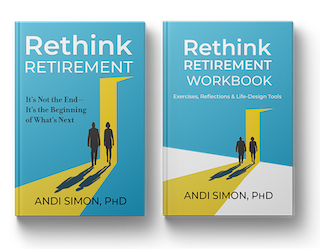
Now–it is time to share our new book with you!
Rethink Retirement: It’s Not The End–It’s the Beginning of What’s Next
Out on Amazon and WalMart, and in your local bookseller and Rethink Retirement: The Workbook
Listen + Subscribe:
Available wherever you get your podcasts—Apple, Spotify, Stitcher, YouTube, and more. If you enjoyed this episode, leave a review and share with someone navigating their own leadership journey.
From Observation to Innovation,

CEO | Corporate Anthropologist | Author
Simonassociates.net
Info@simonassociates.net
@simonandi
LinkedIn
About the Host
Dr. Andi Simon is a corporate anthropologist, keynote speaker, consultant, and founder of Simon Associates Management Consultants. Through anthropology, she helps leaders and organizations understand how people think, why they resist change, and how to create cultures where innovation can flourish.
She is the host of On the Brink, one of the world’s leading podcasts on change and innovation, and the author of several books, including Rethink Retirement, Women Mean Business, and On the Brink: A Fresh Lens to Take Your Business to New Heights.
Her mission is simple:
Help people see, feel, and think in new ways so they can adapt and thrive in a changing world.
Learn More
🌐 SimonAssociates.net
📚 Explore Andi’s books, workshops, and speaking programs.
🎙️ Subscribe to On the Brink with Andi Simon wherever you enjoy podcasts.
⭐ If you enjoyed this episode, please follow the show and leave a review. Your support helps more people discover conversations that inspire fresh thinking.
Check out the entire text here:
Andi Simon 00:00:02 Welcome to On the Brink with Andy Simon. It’s always a pleasure to greet you today, like all of our podcast days, because I’m so happy to bring to you wonderful people who are going to help you do like an anthropologist, see, feel and think in new ways to adapt to changing times. We call this on the brink because I want to get you off the brink, and that means you have to begin to think about things differently. The tendency for people a little anthropology is that you take what you know that story in your head and try to fit the new stuff into it, as if it’s simply a replacement part in some fashion. Remember, the stories guide our daily life, and we believe it to be true. But the only truth is there’s no truth. And so today we have two wonderful women who are going to help understand what’s going on in the world of AI, which is embracing everything, touching everything that you’re touching, and you’re not quite sure, what do I do with this and how do I make it more efficient for me? And is there something here I should worry about? And this all came about after a meeting where a panel of people were talking about using AI for legal issues, for managing their business, for doing marketing, and we said, oh, lots of expectations that are going to lead to disappointment.
Andi Simon 00:01:19 So who do I have today? Let me start here. I have Shelli. Shelli Tench. Shelli is an entrepreneur, a speaker and a marketing strategist who does amazing work. She’s a founder and CEO of Shelli Tin, a digital marketing and brand awareness agency dedicated to elevating brands through authentic connection and strategic visibility. She is truly committed to people over profits, over profits. She has a strong sense of purpose. It isn’t just about the bottom line, it’s about how we get things done. And she spent more than a decade helping entrepreneurs, nonprofits and business leaders grow their impact through international marketing. She has lots more to her story, but I’m going to let her tell you a little bit more about her journey with her. Is Heather Owen. Heather is the founder of Genuine Stewarts, where she helps entrepreneurs and business owners adopt AI thoughtfully, not just quickly. Now, the word thoughtful is a very important one because it’s still filtering through their thoughts. But now we’re going to really pay attention to it.
Andi Simon 00:02:22 When AI tools started becoming accessible to everyday business owners, Heather went all in. She taught herself rigorously, tested everything, and realized very quickly, most people are rushing into adoption, didn’t have any idea what they were doing. And she wrote, anyone helping them build a real foundation, that’s the gap where she does her best work. Now, I must tell you, we all agree that AI is extraordinarily powerful. It amplifies creativity, opens new revenue streams, can really help small teams do things that used to require much larger ones. Makes some people completely eliminated. My copywriter, for example, called one day and said, I think I’ve been eliminated. And I said, yes, thank you. And that was the last time we worked together because I didn’t need her anymore. And it’s not because I didn’t like her work. It’s because there are lots of ways of getting really good copy written today. Not always perfect, but better. So, my friends, let’s start. Shelli, let’s talk about your own journey.
Andi Simon 00:03:24 Then I’ll have Heather’s and then we’ll get to the. What’s happening? How are we seeing and feeling this? And then why is this so important for us? Shelli, please, may I start with you?
Shelli Tench 00:03:36 I grew up. The name of my company is actually Shelton. It’s Shelli Lynch put together.
Andi Simon 00:03:42 My apologies. Shelton.
Shelli Tench 00:03:44 It’s okay. Thank you. it’s a throwback to my dad because my dad is the one that named me, and my dad is the one that taught me my work ethic. And so I named my business after my in honor of my dad. I grew up in Chattanooga, Tennessee, in a religious cult, actually, and I was not supposed to go to college. I was supposed to marry a preacher and be a pastor’s wife. And anybody that knows me now thinks that’s funny because I know. And I got married young, had kids, got divorced, and then at 40 decided to go back to college. And that was a journey by itself. I ended up going to community college first and then a smaller college in Georgia.
Shelli Tench 00:04:31 And that’s where I discovered that all of the things that they had told me as a kid weren’t true. Like, you weren’t good at math. That wasn’t true. You can’t accomplish these things. That’s absolutely not true. And I ended up transferring to NC state. And while I was a student at NC state in my mid 40s, I got asked by NC state to study abroad at Oxford. So I went to Oxford in the summer of 2009, and while I was over there, living my absolute best life, I discovered social media being used in a PR capacity. Now, social media was a buzzword in the United States at that time, much like AI is a buzzword now, and they were very much using it in a more evolved manner than we were. So I came back and said, hey, we should start doing social media. And my professors looked at me like I was crazy. They were like, we don’t because they were still teaching traditional PR, which is what my degree is in.
Shelli Tench 00:05:29 And so I threw myself headlong into learning very much, kind of like what Heitor and I’ve done with AI. There was somebody to teach, so I threw myself into it, and, ended up starting a company doing social media for small business owners in the Raleigh-Durham area, and it has evolved from just creating Facebook posts to. Now we come in. Create strategies to raise your brand awareness. We use online and offline strategies. I always go in and ask my clients, what is the thing you would love to accomplish? But you’re scared to say out loud? And they tell me and then I’m like, all right, let’s figure out a plan to that. Because even if you don’t accomplish that, you’ll accomplish way more than you think you will. Right. I don’t, I just can’t I don’t believe in thinking small. So that, in a nutshell, is kind of where we are right now. I live in Washington state, and I’m relocated out here after spending 13 years in Raleigh because, you know, Covid happened and my kids are here and my family is here.
Shelli Tench 00:06:34 And so I travel all over. and so, yeah, I have clients all over the nation.
Andi Simon 00:06:40 And so Shelli is our dreamer very much. I love it. I think big and let’s make it happen. I love it. And Heather, how about your story?
Heather Owen 00:06:52 So I’m going to stick a little bit more just to the professional story for myself. And that’s that. I’ve been in the digital marketing space since 2016, and there’s been a lot of evolutions of my work in that space in that time. But I ended up working on a lot of high profile teams on the back end. I am very much a systems thinker, and I am very much a big picture person, but I also immediately see all the details that have to happen and fall into place to achieve that big picture. So I have always really excelled in back end operations and don’t always really like to be the front facing person. It’s not as much fun. I don’t love the content, treadmill, that kind of thing. So in that back end work with some of these higher profile people in the digital marketing space, AI of course started to come up over and over, and I started to see it being used and being taught in certain ways, and I knew I just couldn’t avoid it any longer.
Heather Owen 00:07:48 And so I’m the type of person, if I, I want to learn a thing, I want to learn it deeply and really well and then turn around and teach it to other people. It’s just kind of the way I’m wired. And so that’s what I did with AI. And as you said at the beginning, you know, AI is such an amplifier of so many good things, but unfortunately, it’s also an amplifier of risk and exposure if we’re not using it in the right way. And so I looked around at what was being taught in these popular spaces, and I was horrified because I knew people didn’t fully understand the tool that they were wielding. And we’ve already started to kind of see the fallout from that happening and rolling out in public. And so, you know, there’s this saying in the Army that slow is smooth and smooth is fast. And so that’s my message for anybody who is facing AI integration. Slow is smooth and smooth is fast. It’s very true. We want to understand that tool before we deploy it.
Andi Simon 00:08:50 But let’s say I’m Shelli. I’m going to stay with Heather for a moment. What is this thing called AI that we’re talking about? Because I would be helpful if we sort of got more clarity about what exactly you’re thinking about.
Heather Owen 00:09:02 Absolutely. Absolutely. So when I say AI in this context, I’m actually talking about generative AI. You know, AI has been around for a long time and giving us Amazon recommendations, Netflix, Netflix, watch recommendations, that kind of thing, feeding us the right ads we want to see. So it’s not that it’s new, but generative AI is much newer. We didn’t have generative AI until about 2022, at least not public facing use tools. And so when ChatGPT launched in late 2022, that that was the first of the public facing AI tools. so generative AI I is. I’m going to get a little technical, but I’m going to try to keep it. I’m going to try to keep it friendly. We’ve always worked in technology up to this point with what we call deterministic systems, right.
Heather Owen 00:09:52 You put in one thing, you get out and output, and you can be fairly sure and certain that it’s going to be accurate. Right. Very controlled parameters. Generative AI is different because what it’s doing, even though when you’re in a conversation with ChatGPT or Claude or any other large language models, it’s what those are called. It seems kind of like it understands you like, it knows you like. It’s giving your insight. But what it’s really doing is it’s completing a pattern because these are actually probabilistic systems. And every time we go in and type a prompt into that generative AI tool, it’s running a very long statistical probability equation to bring us back the words that are most likely to fit what we have asked it for based on human language patterns, because it’s just working with these huge data sets that our brains couldn’t hold by themselves. But they can hold and parse that data and come back with those patterns. So when AI makes a mistake or has a hallucination, as we call it, it’s because it’s doing its job, the job it was designed to do.
Heather Owen 00:11:00 It’s there to complete a pattern. And when you understand that foundational aspect of generative AI, it helps you understand what’s happening so much better and it begins to help you work with it better to leverage it for better results.
Andi Simon 00:11:15 So let me swing over to Shelley. With that in mind, now that we have this new stuff, a new tool, right. You know, what are all the wonderful things that’s doing in all the challenges that it’s posing? How is it becoming a concern for you, as well as an opportunity you share with the listener or the viewer? What do you see?
Shelli Tench 00:11:36 So the beauty of AI is that it tends to level the playing field quite a bit. For small business owners, they can go in, they can create things that they don’t have to pay huge teams necessarily to create, especially people that don’t have huge marketing budgets. Right. We can create huge campaigns now by using specific tools, which you can’t do if you don’t have any training is go in, plug in random ideas to AI without having a human that knows what they’re looking at, look at it and then come back.
Shelli Tench 00:12:10 So we go in and we’ll, for instance, plug in our client’s brand voice, their values, their missions, whatever it is that they’re trying to get across. Right. And we have specific goals in mind when we plug it in. When we build these prompts, we also build custom GPT for each client that has all these tools. and so we go in and we build these and then we ask it for a strategy. We still tweak it. It still gives us the wrong information. It does it because it’s a tool, right? And so we go in. But it’s a great. It gives you a great I call it like a skeleton to work from. It comes out with a strategy that you can then build on. Now you can go deeper. You can take that strategy. You can break it apart. You can plug each piece in. And I’ve seen it create amazing things and come out with amazing ideas. The other part of it is like we generate a lot of our, blog because we do a lot of blog writing for our clients, and in the past, it has been a very expensive endeavor.
Shelli Tench 00:13:12 You have to write it. You have to hire somebody to do research. You have to hire a copywriter. Yep. Blogs can be very expensive. Right. That’s not the case anymore. Now we build these prompts where it generates blogs because most of them are general knowledge anyway. Right. And it comes in and we’re able to offer that just build it right into our package. And people love it. And we’re able to get it already SEO optimized or geo optimized already. I had a bookkeeper here locally that just her blogs have moved her up to number two on the Google search, just her blogs. So that wouldn’t have been possible before this tool because of the money constraint that you have to pay all these other people. The bad part about it is that now people are convinced they can do it themselves. They don’t understand all of those strategies that I just talked about. They plug it in, they’ll pull something out, they’ll put it online. Case in point I was on a plane talking to a man who works for a very large company that is global, that produces heavy machinery, I’ll put it that way.
Shelli Tench 00:14:18 And we were talking about AI, and he said, look at this. And he showed me a picture that his global company had used AI to produce. Ha! Apparently, nobody looked at it. It was supposed to be a job site of them using this particular heavy equipment, and instead it looked like a carnival. And there was like a food truck and clowns, and they had put it on their website and were using it in their marketing materials. And I said, how in the world did that? How is that? Did nobody look at it? And he said, that’s the problem. They plug it in; they give it a quick glance. They don’t look at it in detail. Right. And then they post it or they put it on their marketing material. That’s the problem with it. It feels like an easy fix and it’s just a tool. And there’s a big difference there.
Andi Simon 00:15:10 Heather, I’ll come back to you and watching your face responding to Shelli’s stories and her commentary. And what are you seeing and how are people, using, abusing and trying to delude themselves into what this is all going to do for them?
Heather Owen 00:15:28 So I would actually like to answer that question, I’d like to sort of share a tale of two companies.
Heather Owen 00:15:34 These are two very large, very public companies. This has all been in the news. So back in the summer of 2025. So not quite a year ago. Deloitte, which is a huge global consulting firm, had been commissioned to do some reports for both the Australian government and the Canadian government. Now Deloitte, of course, is using enterprise level AI tools. That means they have extra security, they have customization, they have a lot more things in place than a small business, a small corporation, or you or I would in our AI use. Okay. So I know that that instills a bit of a feeling of confidence, but it’s very clear that they did not understand that need for continued human oversight that Shelley mentioned, because the reports to the Australian and Canadian government were found the month after they were turned in to be riddled with AI hallucinations, and it cost Deloitte several hundreds of thousands of dollars that they had to refund to those two arms of the government because they had not done their due diligence, did not fully understand the toll, and assumed that it would be entirely accurate.
Heather Owen 00:16:42 They didn’t verify the research. Now, if we contrast that with Ikea, I love what Ikea did. They were contemplating laying off 8500 customer service workers because of AI. They thought they could replace them. But before they made the move, they sat down and really thought through it. And they thought, you know, that’s a lot of knowledge capital to lose at one time. What else might we do? How might we use AI to spark a new revenue avenue? And so what they did is they rescaled all 8500 of those workers. They taught them AI within the context that they would need to use it. And they unlocked a $1.2 billion stream of revenue for Ikea interior design. And I feel like that tale of two companies really kind of illustrates what we’re looking at across the board. You’ve got a segment that’s like, hey, we’re going to replace all these people with AI. We’re going to put the tool in place and not need the people anymore, and we’re just going to forge ahead.
Heather Owen 00:17:45 We can reduce costs, reduce cost, and you can do that, but it’s not really working out very well for some of the companies who’ve tried again, that that Deloitte example, they didn’t even lay anybody off. They just didn’t employ human oversight. So when you start to do the layoffs, you’re definitely removing that human layer. That’s very necessary. Then you’ve got Ikea and the other mindset who says, hey, let’s amplify our creativity, let’s produce new revenue. Let’s see how we can take our existing people and their skills and turn that all the way up to unlock avenues of business we haven’t thought of.
Andi Simon 00:18:20 I love the creative process or the box process. I’m in the box. This is how I do it done. Or how do we get creative about opportunities? I will go research the Ikea story because I want to know how they turned it into $1 billion of revenue. There’s something that needs to be explored and expanded as case studies because, you know, the abstract isn’t useful. You know, data out of context has no meaning, but you put it into meaning like that and you go, how did they do that? I want to do that, you know, where can I get some real benefit of it? Shelli, when you were listening to the panel that you and I were sharing, you were concerned about the misinformation that was being communicated.
Andi Simon 00:19:01 And I didn’t want to ignore or the dilemma of sitting on the sidelines saying, oh, God, you’re making it all bad. Can you share some of the things you were listening to and what you wish they had understood?
Shelli Tench 00:19:15 we were at a conference and we were listening. We were listening to a panel on AI. And there were three. There were five people on the panel, and only three of them owned marketing companies. And one of them, I will not name names, but she is in the financial industry. And she said, I plug everything into AI, and it spits out what I need. And you heard people that knew better guess because we were like, you can’t plug intellectual property into AI. You certainly can’t plug things into AI that have compliance regulations unless you have a tool that has been created to handle that. And Heather can address that more in a minute, because we’ve talked about this because and so we all and I knew she didn’t have that. And so she literally looked out on the crowd, laughed and said, go fire your entire marketing department because you don’t need them anymore.
Shelli Tench 00:20:23 As she sat on the panel with three very successful marketing firms and the facilitator actually has a company that does cybersecurity and AI compliance. And I remember just being aghast that people that run million dollar companies had no concept of what the tool was capable of on the good or bad, because I said to this person later, if you’ve plugged your client’s information in there, you just made it public knowledge. That’s right. And I believe you have broken some laws because I believe in your industry. That’s against the law. Plugging it in. I know there’s I’m not I’m not up on all the compliance issues. And the other thing was that they were saying, you know, you can put anything in there. you can trust it. It has stopped hallucinating. I’ll never forget them saying that. it doesn’t hallucinate anymore. Me and there was another person in the crowd just looked at each other with our mouths just hanging open because it was. A lack of intelligence on display.
Andi Simon 00:21:33 But the certainty was compelling and they weren’t ready.
Shelli Tench 00:21:38 To say such confidence. And I went to the person that ran the conference and said, what? That those people could be liable now. They could be liable. They gave information as a trusted source. That is completely false. Completely false.
Andi Simon 00:21:56 Yep.
Shelli Tench 00:21:56 And why is she even on an AI panel when she owns a financial company? That’s crazy. Absolutely crazy.
Andi Simon 00:22:03 So that’s kind of what the response was. But I do know that you were so upset that we really did want to bring this to the public in a way to set some parameters, not the five rules about why you should or shouldn’t do what you’re doing, but you’re basically outlining. This is high risk and it could give you a high return. But if you don’t understand what you’re actually doing. you know, that’s my buddy, but he’s not he, you know, and unless you’re a critic or at least aware of what’s going on, you’re going to be burned. And welcome to the.
Shelli Tench 00:22:41 Yeah.
Andi Simon 00:22:42 Yep. And I am anxious to see as these begin to materialize what actually happens.
Andi Simon 00:22:47 Heather. You’re smiling. Something to share about Shelley’s. The two of us were sitting there going, oh, really? Please.
Heather Owen 00:22:56 Well, as I explained earlier, hallucinations are not a flaw of AI. It’s literally alternative AI doing its job the way the technology that underpins it, the system architecture is designed to work. It’s designed to complete patterns. We have to know that it prioritizes pattern completion over accuracy. That’s how it was built. We have to do our human verification. And, you know, again, I think that the Deloitte story illustrates that whether you’re, you know, a financial planner or a global enterprise, we have some mass misunderstanding because I think all most of us are going into this with the mindset of these deterministic computer systems that we’ve worked with for most of our lives, not understanding that we’re now dealing with something that is probabilistic. It’s a completely different animal. And now I am no cybersecurity expert. So I want to make that very clear. But I share Shelli’s concern regarding the security because as I explained earlier, if you’re not an enterprise level company like Deloitte, where you have an entire staff of security experts who are working with AI, who are performing audit log audits and all the things that are above my pay grade.
Heather Owen 00:24:11 Right. Then you’re using what we basically call public facing AI or public AI. And the problem is that there are thousands upon thousands of bots being run by the cybercriminals daily targeting users like you and me, because we are small business. So if you’re putting personally identifiable information into that and then let’s say you’ve set up agents or you’ve connected your AI tool with other tools, you are super vulnerable, and now you’ve exposed your clients to that same vulnerability, just if their information exists in your email. You know, you think you’re just keeping your email inbox straight by having an agent perform sweeps daily. But those bots that are out there scouring, looking for those vulnerabilities can come and inject a prompt that pulls all the confidential information out of your email. So we just have to understand the dangers. There’s so much powerful, good, amazing opportunity created by AI, but it has also exponentially multiplied the risk to the same degree. And we just have to be aware. We just have to be responsible. We have to learn about this powerful weapon, basically that we’re holding.
Andi Simon 00:25:22 I hope, I hope.
Shelli Tench 00:25:23 I hope you.
Andi Simon 00:25:24 Find the head. Shelli.
Shelli Tench 00:25:26 Heather and I are best friends at that conference. As soon as I left the panel, I stepped outside and called her and I could barely breathe. I was so stunned and I called her and said, am I overreact? This is crazy, right? Am I overreacting and shared with her what happened? And we had we had a long conversation about it. And then the woman that facilitated the panel came up to me afterwards. And she also the state of shock was so. Deep and profound. And then you saw us shortly after that. So, yeah, it’s like holding it’s like it can be a tool or it can be a weapon.
Andi Simon 00:26:10 Well, but we don’t know what it is, and it’s not going to shoot you, but it is going to kill you. And it becomes important to have some do’s and don’ts. Have you found some, you know, the 3 or 4 or five things one should do or not do when using this as a vehicle, a tool for answering a problem or a question.
Andi Simon 00:26:31 Heather, anything to, you know, help our listeners become more aware of because we’re not doing a training today. We’re doing an alert.
Heather Owen 00:26:39 Right? Right. So I would say, you know, the first thing is just very, very thoughtful about what information you’re giving it. and also, you know, go into your go into your settings in whichever large language model you’re using and turn off their ability to use your chats for training data. That’s just an extra little layer of protection. you know, never give it any personal, personally identifying information. We call it. Definitely don’t feed it proprietary information of a client. Maybe any kind of, frameworks that aren’t copyrighted yet or trademarked yet, you know, that could, give you an exposure there. And one of the biggest things that I think people don’t realize, especially with a lot of image generation and video generation, is that they need to be keeping what we call provenance logs. And that means that you need to have a record of the prompts that you use to the date that you created this thing, the tool that you created it in.
Heather Owen 00:27:40 Because without that, you have no basis for copyright. You have to prove significant human creative direction in that process. and it’s not just about being able to get copyright. It’s also being able to protect against copyright infringement. And a lot of that is just very in flux right now because of the way some of these models were trained and some ongoing lawsuits. And we really don’t know how all that’s going to turn out. so it’s, I guess, document. Right? That’s kind of been the cardinal rule of business our whole lives, right? Document everything and hold onto to that documentation. and just take a lot of thought and care before you enter information into it.
Andi Simon 00:28:18 Interesting.
Shelli Tench 00:28:19 I would say we built custom GPT for people. And so what we plug in that we have found super useful is we go in and find out their brand voice, we found out their mission, we find out their statement, we find out and we plug all that. We built that into it, which helps us create some really good stuff.
Shelli Tench 00:28:38 I still tell people to this day, I really need you to give me original photography, because AI generated visuals do take algorithm hits sometimes. A lot of times, and like especially with Google, especially some of the platforms, they will straight out just, you know, red flag. And I’m like, why don’t you get some good visuals in there and then like the photography still rings. Video is still king. Right. Create your own. And then. Because the other thing is that people still want that human touch. People can now are starting to be able to recognize what’s AI generated and what is genuinely created. Right. so it’s been great for when we plug all that in, producing some really quality good, you know, content and ideas and stuff. But like she said, we also keep every prop that we build for people so we can go back and say, this is how we got to where we are now, which also helps us train the AI because we can see in the prop, okay, we need to build this better here.
Shelli Tench 00:29:46 We needed to add that information there or like that whole thing. You do have to keep detailed records; you really do of how you got to where you are. So and it’s still going to hiccup. It’s I work with an A company in Raleigh that has been in Raleigh for 30 years. And I swear to you, every time it produces something, it says it’s in Texas and I don’t I don’t know how to I don’t know how to make it. Every time I go, it’s in North Carolina. Oh you’re right. I know. I have arguments with it all the time.
Andi Simon 00:30:22 Well, you had the same conversations with your chat buddy as I do, and I it is everyone is learning on the job and trying to stay out of harm’s way at the same time. and I don’t think we’ll cross a threshold which says you’ve arrived. It is now safe. It is now protected. because the whole nature of it is to take data and make patterns out of it. And if the data isn’t good, there are no good patterns coming out of it.
Andi Simon 00:30:49 And you’re making it’s making stuff up and so are you. And they’re not the same. Claude is different than copilot is different than Gemini is different than, than chat. So and then you say to yourself, well, how can each of them have a different way of creating the pattern? Heather go ahead.
Heather Owen 00:31:07 I can actually answer that question. So it’s because the different large language model platforms had different training approaches in the beginning. Right. They had different priorities, different developer priorities and plot or anthropic. They have what they call a constitutional approach to training. And so they had safety and rigor in mind first, far more than at any of the other LMS in terms of developer priorities. they have different context management, different waiting, a longer context window. So there are a lot of other technical components and how they’ve built their version on top of the transformer model architecture that go into that. The Gemini system is within Google’s ecosystem, so it excels at anything when you’re talking about like conversion strategy and local SEO and Geo, and it does a lot more than that.
Heather Owen 00:32:00 But anything within that Google ecosystem it excels at. You know, Claude is much better for long form content because of the way they manage that context, the way the waiting is chat is great for creativity because it’s not going to interrupt your brainstorming so much. It’s going to kind of flow with you. It gives you good scaffolding. They definitely are not built equally, and they cannot escape their original scaffolding no matter how hard they try. Because once you start, it’s kind of embedded. You can try to alter it, try to change it. We watched chat do that as it’s tried to become more responsible and stop certain what we might call moral failures in, in its conversations. but it’s found it very difficult to do that and to do it successfully. And then they have come a long way. But again, we’re not training. This is just an awareness thing. So.
Andi Simon 00:32:52 Well. But it is Experientially. You can ask each of them basically the same prompts and see how different the responses are.
Andi Simon 00:33:02 And then as a human, you have a problem of figuring out which one is the right one for you to use, for what purpose. And it makes it pretty interesting about how your buddies in each of them can see the world through very different lenses, and they are intentionally designed to do that. So it’s, it is an interesting time. So remember, let’s we can probably begin to wrap ourselves up. The whole point of this podcast is to take people off the brink, to get them off the brink, and to help them see, feel and think in new ways so they can do better. So the last couple of thoughts you’d like to share. May I start with you, Heather? And then I’ll wrap with Shelli. a couple of things.
Heather Owen 00:33:44 so I would say the last thing is there’s such a huge push right now to just adopt a genetic AI process, and that is autonomous decision making that you are turning over to AI. So I just want to throw up a big, huge, giant red flag no matter how much it’s being pushed.
Heather Owen 00:34:01 Please, please, please do that very cautiously, if at all. but, you know, don’t be scared of AI. Just get educated about AI. Just get some understanding. You know, you don’t know how to know how to build the engine, but you do kind of need to know how it works under the hood so that you don’t put the wrong kind of gas in it and get stranded on the side of the road when you’re trying to get to your destination.
Andi Simon 00:34:24 Thank you. That’s a great, metaphor. because that’s just how people feel like, well, what do I do now? And I, am I going to delete it or what am I doing with it? So. And Shelli, your last thoughts, ma’am?
Shelli Tench 00:34:38 I would say that I remember when social media started and people were hesitant about getting on social media because it was that social media thing, right? They waited. And then by then the people that were on the train were already ahead. And I told people.
Shelli Tench 00:34:52 Social media is an eight ball. You can be in front of it or you can be behind it, but once you get behind it, you’re never getting in front of it. Now is the time to adapt AI. However, it’s a tool. Don’t forget it’s a tool. And what really, really, really helps small business owners is human connection, right? So I think the businesses will thrive that use AI to enhance their human connection and not replace it. and that don’t be afraid of it. And if you are afraid of it or you don’t know, there are people out there like us that do know. Ask us questions. Ask us for help. You know, I think it comes across as a very easy thing to do. And it’s not just like marketing. It’s not a super easy thing to do, even though it looks that way. Go find somebody that’s an expert in it. Let them help you. Ask them to train you. but don’t be scared of it. I know a lot of people are terrified of it right now, but you’re not going to escape it.
Shelli Tench 00:35:47 You’re not going to escape it. so.
Andi Simon 00:35:50 Yeah, I’m. I’m laughing. We went out for dinner with an old friend of ours who was an accountant, and he leaned over the table, and he said to us, so, do you guys ever use ChatGPT? And I looked at Donald and my husband used it all the time, and, and I’ve been using it for, for a number of years. And I said, okay, Donald, is this a trick question? he said, well, none of my clients use it. I said, well, that’s a segment of people who are your clients, but we’ve been using it since, I don’t know, as soon as I discovered it, I did a proposal that I got a, an ethnographic research project in 2022 on it. So, you know, now the question is, how do we use it? and oh, by the way, I like Claude for my long stuff and Chad for my short stuff, and copilot took lots of transcriptions and help make sense out of them.
Andi Simon 00:36:43 And each of them is different. How do you use it? And he said, oh, you’re ahead of us. And I laughed and I said, well, just, you know, keep moving along. It’s, and a very smart guy. But he was very, very concerned that his clients and he was keeping them in the dark.
Shelli Tench 00:37:02 Shall we? He’s in that count.
Andi Simon 00:37:03 Okay. Yeah.
Shelli Tench 00:37:06 It’s funny to me that people use ChatGPT instead of Google Now. That part is really funny. And that’s where geo optimization comes in. Because if you want your stuff to be found when people are googling using ChatGPT, I hear people tell it all the time, I use ChatGPT instead of Google and it just boggles my mind a little bit. It’s kind of funny. I’m like, for what?
Andi Simon 00:37:31 Well, for whatever chat will find for you. But I actually asked my buddy, you know, how do I make sure that I’m optimized for, gen of AI and gave me a whole list of what to do, and, and, and you can go to Google and do that as well.
Andi Simon 00:37:46 I, I my job is to stay on top of all the search. You know, you’re looking for and, you know, a corporate anthropologist. Cultural anthropologist. You want someone to help you change? I want to be on the top of your search, whatever you’re searching at. So it becomes an interesting time for us. Am I right?
Shelli Tench 00:38:03 Yeah, yeah.
Andi Simon 00:38:04 All right, my friends, we’ve had two wonderful women here today to talk about this new world that we’re in. And it is a time for us to sort of say goodbye. I did mention that Heather has a YouTube channel called clarity first AI, and it’s there. Shelli, do you have something that they could refer to as well? Because I didn’t see it on your, bio some.
Shelli Tench 00:38:28 I, I just connect with me on LinkedIn. yeah, I would say that you can find it in my name. Yeah.
Andi Simon 00:38:36 Or Google search for Shelton, right?
Shelli Tench 00:38:40 Yes. Or Google search for Shelton, which is LTE in.
Shelli Tench 00:38:44 There’s no O in the name. yeah. Where you can search that. So.
Andi Simon 00:38:49 Good. for all of you who do come, I truly appreciate it. it’s great to share with you folks who are going to help you see, feel, and think in new ways. Our books are all on Amazon, and they do love your reviews, and I appreciate it as well. And now that we’re rethinking retirement, I will tell you there are 75 million boomers who are rethinking life. And I’ve written a couple of articles for my Substack post and for LinkedIn about how, all the new technology is going to impact on us getting older. And I don’t even want to talk about on the retirees because they don’t want to be called retirees. They don’t even know what they want to be called. So there’s a new world that’s emerging. But, you know, technology is going to be extremely important in many phases of it. So I’m going to say goodbye. Please have a great day. Don’t waste the day.
Andi Simon 00:39:35 It’s every day is a gift and I’m enjoying sharing with you. Bye now. Bye, ladies. Take care. Bye.
Shelli Tench 00:39:42 Bye.