


Summary
Retirement is often framed as a personal milestone—a moment when we step away from work and into freedom. But what if retirement isn’t just about leaving a job? What if it’s about navigating the deep relationships, identity shifts, and responsibilities we carry with us into what comes next?
In this episode of On the Brink with Andi Simon, I speak with Katherine Crewe, a Tech/Vistage chair in Canada, whose thoughtful approach to retirement reveals a powerful truth: transitions are not events—they are processes.
The Myth of the Clean Exit: Leaving Work Isn’t Leaving Relationships
Katherine’s story challenges the idea that retirement is a simple, clean break. After decades in biomedical engineering and leadership, she moved into a role guiding CEOs and executives. Now, in her late sixties, she is not “done”—she is reflecting, recalibrating, and carefully designing her transition.
What makes her journey so compelling is this: she is not just leaving a role—she is stepping away from a community.
As a chair, Katherine has built deep, trusted relationships with the leaders she supports. When she began discussing retirement with them, the reactions were emotional and varied. Some encouraged her to stay. Others supported her decision. Many wanted one thing above all—a thoughtful, gradual transition.
This wasn’t about replacing a position.
It was about preserving relationships, continuity, and trust.
Retirement Is a Social Transition, Not Just a Personal One
One of the most important insights from this conversation is that retirement impacts more than the individual.
Katherine realized that stepping away from her role felt less like leaving a job—and more like leaving a network of meaningful human connections. The responsibility she feels is not just to herself, but to those who depend on her leadership.
This is a critical lesson for organizations as well.
As Andi notes, companies are facing a “senior tsunami”—a wave of experienced employees approaching retirement. Yet many organizations still treat retirement as an administrative process rather than a cultural transition.
What Katherine is modeling is something different:
- Thoughtful succession planning
- Gradual transitions
- Honoring relationships and institutional knowledge
This is where anthropology becomes powerful. It helps us see what is really happening beneath the surface.
The Paradox of Choice in Retirement
Unlike traditional roles, Katherine’s position has no fixed retirement age. She could continue indefinitely. And that creates a new kind of challenge—the paradox of choice.
If you can keep working… should you?
Rather than choosing between “all or nothing,” Katherine is exploring a more nuanced path:
- Reducing from three groups to one
- Staying engaged in meaningful work
- Creating more space for personal life and exploration
This is a powerful reframe. Retirement doesn’t have to be binary. It can be designed.
Preparing Before You Retire
Perhaps the most valuable insight Katherine offers is that she has already been preparing for retirement—without calling it that.
She has:
- Structured her own time for years
- Built her identity around relationships, not titles
- Prioritized wellness as a daily practice
- Maintained independence in how she works and lives
As a result, she does not fear the four common retirement pain points:
- Loss of identity
- Lack of daily structure
- Unclear purpose
- Disconnection from community
Why? Because she has already built a life that isn’t dependent on a job to provide those things.
This is the real lesson:
Retirement is not something you enter. It is something you prepare for—while you are still working.
Couples, Conversations, and “Confetti Moments”
Another powerful theme in this episode is how retirement impacts relationships at home.
Katherine and her husband are both still active, both thinking about the future—but not always in structured ways. Instead, they have what she calls “confetti moments”—brief, scattered conversations about what retirement might look like.
This is deeply relatable.
Many couples don’t sit down and design their future together. They talk in fragments. And yet, retirement will require alignment:
- How will we spend our time?
- Will we keep working?
- What does “being together” actually look like?
Without intentional conversations, these differences can become points of tension.
What This Means for You
Katherine’s journey reminds us that retirement is not an ending—it is a transition into a new stage of life that deserves as much thought and care as any career move.
It is not about stopping.
It is about redesigning.
Key Takeaways
- Retirement is not a single event—it is a gradual, human transition.
- Leaving work often means leaving relationships, not just responsibilities.
- Organizations must treat retirement as a cultural and strategic issue, not just HR process.
- The best retirement transitions are designed, not abrupt.
- Preparing early—by building identity, structure, purpose, and community—makes all the difference.
- Couples need intentional conversations about what retirement will look like together.
- You don’t have to stop working—you can redefine how you work.
Learn more about Katherine Crewe:
Katherine’s profile: linkedin.com/in/katherinecrewe
Connect with me:
- Join my Substack Newsletter Rethink Retirement
- Website: www.simonassociates.net
- Book Website: www.andisimon.com
- Email: info@simonassociates.net
- Learn more about our books here:
Now–it is time to share our new book with you!
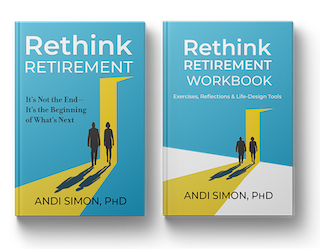
Rethink Retirement: It’s Not The End–It’s the Beginning of What’s Next
Out on Amazon and WalMart, and in your local bookseller and Rethink Retirement: The Workbook
Listen + Subscribe:
Available wherever you get your podcasts—Apple, Spotify, Stitcher, YouTube, and more. If you enjoyed this episode, leave a review and share with someone navigating their own leadership journey.
From Observation to Innovation,
CEO | Corporate Anthropologist | Author
Simonassociates.net
Info@simonassociates.net
@simonandi
LinkedIn
Here is the complete text:
[00:00:00] Andi: Welcome to On the Brink with Andi Simon, thank you for joining us today. I’m Andi, and as you know, my job is to get you off the brink. I want you to be a little like an anthropologist. It’s a time of change for you personally, for our society, but you may be going through some interesting questions about who am I?
What’s my identity? Where am I moving to? And so I’ve been doing this wonderful work around my book called Rethink Retirement. And in the process of interviewing people, I found many, many who would like to share their stories with you for a variety of reasons. Today, I have Katherine Crewe here with me and Katherine, thank you for joining me.
It’s such a pleasure to see you again. And Katherine is in Canada and she’s a tech chair up there. And I think that there’s a story here that everyone should listen to because nothing is as simple as simply saying, I’m going to, it’s time to retire. Let’s do it. If you have lots of choices, and retirement is a new stage for most people, as I discovered in all the research, I was doing that nobody practices him.
Nobody is really sure what they’re going to do in it. They’re convinced they want it; they made it. It’s like a great moment. And then what happens? All kinds of different things. Let me read you Katherine’s bio so you have a sense of who we have today to listen to. In her role as a Tech Canada chair, Katherine assists executives and business owners in reaching beyond their limits.
Now remember, I’ve done 500 Tech and Vistage Talks, and I’m a speaker for this organization, so I fully appreciate the work she does to help their members really see, feel, and think in new ways. Their job is to help educate them and inspire them. She knows that their job is to match ambitions through a unique peer advisory board experience.
Tech. She’s held senior positions in several global pharmaceutical and medical device companies. So she comes to this role from a different background. She managed Canadian operations prior to her role within tech. She has a Master of Biomedical Engineering from McMaster, a bachelor’s in chemical engineering from Queens University, an institute of corporate directors designation, and is a fellow of the Canadian Academy of Engineering.
Wonderful, wonderful woman for us to share. So there’s no straight line, but she’s at an interesting and important point in her life where she’s going through thinking about this seriously, and it’s a really important process for us to share it. Katherine, thanks again for being here. Let’s share your story.
Tell us, tell the listeners who is Katherine, I read your bio, but it’s much more interesting when you talk about your own journey. That leads up to where we are now, please.
[00:02:51] Katherine: So as you’ve described, my background was really in biomedical engineering and engineering associated with the device in pharmaceutical manufacturing, particularly in operations.
Enjoyed my career immensely. lot. Got to work with lots of wonderful people from all over the world. And then I came to a point where I really wanted to challenge myself and do something that I had never done before, sort of as my last raw. And that’s when I found, the chairing opportunity with Tech Vistage.
And it did not disappoint. It has made me grow and stretch in ways I could not have imagined when I started this journey. I currently have three groups, two groups of CEOs and business owners, and one group of key executives, which are the C-suite in most of those organizations. I’ve been doing this now for about 12 years, and as I approached, my late sixties.
it’s really hard to decide how you swan song outta what you’re doing and how you approach what you’re going to do next, which is when one of our fellow chairs put out a call for, for Andi on, chair net. If anybody was interested in, sharing what was going on. I thought this topic was extremely interesting and leaped at the opportunity to get involved.
[00:04:12] Andi: But you talked about how you have been thinking about this and working with your members to begin to understand this. This isn’t sort of like, I’ve arrived. Mm, all done, thanks very much. Off I go and retire. There’s obligations to them. There’s relationships with them. There’s a community around it. I love the stories you were sharing because it was very personal and very human.
Share a little bit.
[00:04:39] Katherine: So, I mean, we call this thing issue processing within the Vistage community. And so one of the, the year I turned 65, actually the month and the year I turned 65, there was a lot of mixed emotions around the social, implications of being 65. my parents both retired by 65 and so I processed the issue of my retirement with my three groups and got their feedback.
I, I don’t know what I thought was going to happen or what to expect, but, but it was, it was quite a range and, I hadn’t really thought it was that I was going to get, that kind of information was going to come back to me. So, many of them didn’t want me to do it. Some of them said, it’s your life. You do what you need to do.
I, I understood at that moment a different sense of, it’s not just a job. These people have tight relationships with me as their chair. And so it wasn’t quite like leaving or retiring from a company this was leaving and retiring from, a relationship. I mean, I wouldn’t call it a divorce, but very close to those kinds of feelings, which I didn’t anticipate.
when I brought the, the notion up with the guys and the girls.
[00:05:56] Andi: Well, but you know, Vistage, for those of you who may not be aware of it, it is not simply, young Professionals organization or a YPO kind of thing, ,, it is a fraternal or RA sorority kind of, intimacy that begins to develop where the group trust each other.
To speak with honesty about each other’s businesses. And the chair, Katherine, in this particular case, plays a, a really seminal role in helping them work through key issues, and that’s why it was such an interesting story to share in the book. What kinds of things did the folks say to you, other than maybe you should or maybe you shouldn’t?
Mm. Kinds of. cause you do one-on-ones with them. And I have a hunch the conversations kept going beyond the group.
[00:06:44] Katherine: Right. I mean, they, first of all, they kept telling me, yeah, I didn’t, you know, I went, didn’t look my age and I shouldn’t worry about the age and sort of that whole piece, which I appreciated, of course.
but, I think, I mean they, most of them liked the group and I don’t think just me being there would, would necessarily end the group. So I think what they wanted me to do was try and find a good succession. Which is hard to do. I think I found one, actually. I’ve met someone recently who I’ve known for a long time, but she’s suddenly in the spot where she thinks she might want to be a chair.
So I may have found my, my ticket for that. So I think they wanted, they wanted a slow transition. They wanted it gradual. They wanted to break in the new person. if there was going to be one. some outright said that they would leave when I left. Don’t know if they will or they won’t when the time actually comes.
and so, so I, I do feel responsible for the smooth transition more than just, than I would if it was just a company and I was just moving a department or something like that. So I guess I’ve, you know, I’m spending a lot of time not only on my, what my own personal, retirement looks like, but also the exit process is going to be for this particular role.
[00:07:59] Andi: And you know, this is a little different than a company. As I’ve been doing my research and we were talking briefly, the companies are beginning to realize that there’s a huge senior tsunami where so many of their staff are going to be facing exit strategies of different kinds, and they have different impacts.
And so what Katherine’s talking about has implications for whatever kind of business you have because the people who are behind, who are left behind need to know what kind of continuity is there. What do I matter? And the person who’s living, leaving is beginning to think through what comes next for them.
And you’ve been really very thoughtful about not only them, but also your own transition. So you’re not simply, I made it to 65. Let’s get outta here kind of person. Talk about this transition for yourself.
[00:08:52] Katherine: Well, the interesting thing about this particular role is there really is no age limit. I mean, that’s right.
No, in the community, Andrea, there are chairs that are in their nineties and are still chairs, so, so there’s no, there’s no, like companywide expectation, you, I can do this as long as I choose. And so that’s kind of an interesting, angle in all this cause it’s not your typical kind of role. So that has also weighed, because I look around and say, well, I could do this till I’m 90 if I want to, a lot to do.
I don’t have to slow down. I don’t have to, you know, stop or whatever. So part of me is thinking about keeping one group and keeping going and still, so it’s, it’s slowing down on, I mean, three groups is a lot. So slowing down maybe to one group and still having my hand in do something that I love.
and, because the option is there and I can, so that, that is, that’s not necessarily everyone has that freedom.
[00:09:52] Andi: With that is a freedom you have the paradox of choice. How will I know what to do that’s best for me and for them? And this becomes, challenging. It’s not simple. I can stay forever or I can get more time for myself and also stay involved.
But you have a wonderful spouse, and he has been part of this whole journey with you. You know, would you share some perspective from his perspective? What would, what does he want you to do? Because nothing is easy.
[00:10:20] Katherine: Right. Yeah. I mean, he works, he works crazy hours. He’s still, I mean, he is, he is still in the mix, with, lots of activity.
Although, I mean, he talks, we talk, we talk, I call it confetti moments because we’ll have little snippets at the dinner table or when we’re driving somewhere and he’ll make like a, a pronouncement about something when we, you know, when we’ve retired. I want to do this or whatever. So we, we kind of have this conversation in little bits as opposed to sitting down and sort of thinking about this in, in a, a more linear fashion, which I find because I’ve been, I’ve been collecting, I collect all of your newsletters, Andrea, I have them all PDF in a, in a on my remarkable.
And my plan is to sort of go through some of those questions and then he and I actually have a conversation about some of this stuff. And we actually have more than a confetti moment to do that. So, but at the moment he, I think he’s thinking about it too. but he is just so busy doing what he’s doing that it hasn’t really allowed a longer thought process than the odd snippet on an occasional day.
[00:11:23] Andi: Yep. Now, are there things that you can, so I’ll put it into my own personal life. my daughter’s finished college. My husband was president of his company, me of mine, and I said, I’m not going to wait to retire to travel. I’m an explorer. So we’ve been to 40 countries every 90 days. We went away. And he sometimes in a hot air balloon over Africa was getting text messages and so there was no shortage of ways I could do work from Vietnam or from NormAndi.
Nobody knew where we were and didn’t care. but as long as we could stay balanced between family and work and travel and things that we enjoyed. we had a wonderful, long and happy life. I’m going to have a hunch. You and your husband share many of these things now, and then you wonder, well, what will retirement mean for us?
We’re not struggling, or are you?
[00:12:14] Katherine: No, no, no. For sure. But it’s interesting you say that because you know, every time, I mean, every holiday or vacation we’ve had, even as a family, but when the kids were growing up, always was text messages. Anytime. You know, we have a joke when we used to take the kids to camp and stop at the top of a hill so he could get a phone signal so he could be on some sort of conference call, and the kids had to sit perfectly still.
[00:12:41] Andi: I’ve had the same ones,
[00:12:44] Katherine: Paul, right. And so, but I mean, even when we went last year, we did. So we are trying to do, as you described, but. He did the same thing. We went to Gas Bay and did the route, for 10 days last year. And he did work every day. And you know what, Andrea? I didn’t like it.
[00:12:59] Andi: Yeah.
[00:13:00] Katherine: And so I, and it’s, I guess because it’s always been like that.
And so when he was doing that, I was thinking, what will it be like when we actually go someplace and we don’t do that? Yeah. So that was kind of what was going through my mind, when he was doing that. We could, and we could, as you say, work from anywhere. But I think I’ve decided I don’t want that.
[00:13:21] Andi: Yep.
And now the challenge might be, you semi-retire or you slow down a little bit, or you stay busy and he doesn’t. And that poses other challenges. And some of the couples in the book and others who I interviewed. Are facing that dilemma. because whether it’s the man who retires and the woman is still working and he wants to know, when are you going to retire too?
Well, I’m not going to, or the woman, you know, is, is, you know, is, is retired and the guy isn’t. It makes for new. Conversations. and it becomes important to be open. it’s, it, it, you know, when you do this in the Vistage world and you have a key thing to work through, it’s not that different in your private life.
We have a problem we have to talk about. but you also don’t know what it would be like cause his habits are, his habits and yours are as well.
[00:14:16] Katherine: Right. I mean, we’ve always had very, different hobbies and so none of us, we don’t really depend on each other. Like he’s a sailor. I don’t have any desire to be on his boat, so I mean, we’ve got very distinct activities that keep us interested.
He does want to slow down. I mean, I think we both agree that we don’t want to give up everything entirely like he likes doing. He does a bunch of volunteer work, or he gets paid with equity as opposed to any kind of a salary for some startups. He thinks he’ll probably continue to do that. I would probably continue to cope or do something.
So we both agreed that we would keep our fingers in some sort of active business role just to keep our brains, sharp so that we agree on. So, you know, that would be a limited number of hours a week, but we both recognize that that’s something we want to keep doing. yep. And would and would make time within our relationship for each other to maintain that.
For sure.
[00:15:11] Andi: Lemme ask you a question as you’re thinking about this. The things that I’ve learned doing the research, being curious like I am, is that people fall into four pain points. The first one is, who am I used to be, and now I left my business card. I don’t know who I am. And the identity challenge is a very serious one because we wander around and often it takes a year for the honeymoon to wind down, but you’re looking for what’s my next?
Who am I? The second one is my daily structure. Some of the common themes that people would tell me is that I got, went to the gym, I had my coffee, I have nothing else to do all day. And that is for a very busy person. One of those, oh my gosh, what have I done? cause I have no idea how to structure this.
The third thing is, what’s my purpose? You know, why? Why do I matter? And I knew what I did. But now what am I going to do? And then the last one is very unsettling because they had all these friends in the company and they realized that when they left the company or they left their business, or they sold their business.
They didn’t have any friends and the folks in the company could only have lunch with ‘me so many times and had little less, less to talk about. And I met someone at a networking the other day and I was writing about it because he said to me, my friend left the company and he wants to have lunch like we used to, but I have nothing to say to him.
It’s gone and I don’t know what to do. As you’re thinking about this, you are not intentionally thinking about ‘me in those four categories, but do you have some observation or thoughts to share as if the audience were listening today and, and you’re talking as, as you do with your own members about the wisdom of preparing for the next stage?
Because I do think that becomes the gift that we can give is to, you don’t have to just jump. You may need to understand what’s coming next. Some thoughts.
[00:17:17] Katherine: It’s interesting as I, I was listening you describe that, I guess, at some point during my chairing, I thought of it less as a job and my concentration or my, my message to myself is I build relationships with me and, you know, within the group.
And so having, having. Building relationships is what I feel I do. And so I don’t see a time fence on that. I would still meet people, build relationships. I mean, I may have relationships with my old alumni members. I might have new relationships with people in the, in the neighborhood or the community. So to me, my frame is I go out and I love to meet new people, and I am all about building the relationship.
And so. I don’t feel any of those four things, quite frankly, that, that, that I think will stay the same regardless. That’s just sort of part of what I am now. yeah. And so I think, I won’t have a, I won’t have a problem with that transition. it’ll just be a different pool of people to meet and have relationships with.
[00:18:24] Andi: Good. But your purpose will, if you can stay and manage one group, you’ll still have that as a purpose. Yeah. but you’ll also have more time for yourself, for self-care, for, you know, hobbies that you enjoy for traveling without being on the texting. and it’s, it’s interesting health. One of the other themes is.
Several of the people I put into the book and several others, didn’t take long. Retirement came four months later, they had breast cancer. One woman said, I sold my practice and the next day I had breast cancer. One gentleman said I sold my business and then I had a serious cancer. I mean, like cancer is waiting inside.
Mm-hmm. do you have concerns in those regards or is it simply I’m not going to worry about that. I can’t pay attention.
[00:19:12] Katherine: I mean, I’ve always been very conscious and wellness is a sort of central theme of how I organize my life. I went through this exercise once and we have to sort of wound it down to one word that’s going to represent you and oh, what represent what you’re going to be about or whatever.
And so wellness was my word. So I’m very conscious of my eating, of my exercise, of my. Relationships I build my day around and my week around the word wellness, I meditate. So I have a really strong structure around my wellness. I go and have, you know, I go to the dentist, I have all my tests done, and so I’m not really, I mean other than my eyesight, which is going to fail, I haven’t really got a worry about any other ailment that’s going to pop up.
[00:19:59] Andi: But you said something very important. You do this. You’re not going to stop doing this.
[00:20:05] Katherine: Right.
[00:20:06] Andi: And I do think the message that I’m hearing and that the listeners should pay attention to is that if you’re prepared well for life now, before you retire, then the migration or the, the transition into the next stage will be intentional.
you won’t worry about the lack of someone, because right now, as a chair, nobody structures your day, does it?
[00:20:27] Katherine: Nope.
[00:20:28] Andi: So you’re already sort of halfway betwixt in between freedom you, you left, you know your engineering positions and you’re now free to run these companies, these groups, the way you think is best.
And nobody looks over your shoulder, do they?
[00:20:44] Katherine: Nope. Nope. And you’re right, you structure your day. I mean, you know, , I am always in awe of chairs that I meet in the US with lots more groups than me and only work two days a month. And I’m like, I don’t know how they do that, but.
[00:20:57] Andi: I don’t either,
[00:21:00] Katherine: but also, I can, I can structure, I can take Fridays if I don’t want to have any, I mean, I’m the one who controls when the one-to-ones are.
so if I don’t want to work on Fridays and Mondays, I don’t have to work on Fridays and Mondays already.
[00:21:11] Andi: Yes. So.
[00:21:12] Katherine: Or, or Wednesday or a Tuesday afternoon. and so yeah, I’ve already, I’ve already started. I mean, it’s been like that now for 10 years, so that’s not going to be hard. And I’ve also learned, I mean, I mean, you say like when, you know, you asked me today, and this was my only appointment today, and so I decided this morning, you know, I was going to make very good use of that open space.
I was supposed to have a one-to-one. It got canceled yesterday at the last minute. So I had open space and I thought, okay, I’m going to be very deliberate about what I’m going to get accomplished today. And so I’ve already got that, sort of, and that will carry me.
[00:21:46] Andi: Well, it’s interesting, I met a woman, she participated in, the first intensive, seminar that I did, and she had 18 things on her to-do list, and she was having trouble getting organized to get them done.
and prior to being retired, she was structure. And the structure to non-structure was unsettling for her. cause in the absence of external structure, she was lost. What you are describing is a way of preparing because you’re already in this wonderful transition, from the corporate to being an entrepreneur, being independent, and being able to understand how I can use my time in a way that balances my obligations to my members as well as to myself.
This is really sort of a wise. Woman for my listeners, listen carefully because whether this is what you do or you’re still in a corporate environment, begin to plan experientially. How are you going to take charge of your day? Begin to think about the meetings you’re at. Which ones should you be at?
Which one should you be at? You know, I have a handshake. Katherine was often at meetings prior to this career where things weren’t exactly the way we should do them, but we went along. But now is the time for you as you’re thinking about the next stage, to take some control, begin to see how you manage your all, all the things that matter to you.
You had shared some things about your members who are CEOs of their own companies. Is there one or two things you can share about how they’re beginning to see as you serve as a role model? In a sense they’re also beginning to think about their own company.
[00:23:24] Katherine: Yeah, so I have, you know, there’s a lot of companies that have older employees, and, some never want to stop work, but there is going to be a sort of maybe a physical limitation.
And so the conversation we’re having now is how do we have the conversation with these 70 year olds that are. Still in the workforce. how do we, how do they approach, the succession capture all the village knowledge that these people will have had for 40 years doing the business and do it in a respectful way that honors the contribution they’ve made to the growth of their organizations?
I don’t think, I mean, UN until Andrea sort of presented that in a newsletter for me, I don’t think we were, I was thinking of it in that organized fashion, and it’s given me a quite a nice framework to have these conversations, with my members.
[00:24:13] Andi: I’ve had a wonderful conversation with you today. I can’t tell you how much I appreciate it because you make the book Come Alive and I share that each one of them and I’m trying to get as many of the folks in the book and the others as well to begin to tell their stories.
cause I do think we hear differently than we read. And while you can read it, you’ll impose on it your own sense of what that means. And now you listen to Katherine Crewe talk about her own journey. And it is, it is really inspirational. It’s like, oh, I can do this but do it wisely and understand the next stage.
Call it the next stage, or retirement, or the next phase. Remember, we’re living, she’s in her sixties. My father went to a hundred. Do I want to live to 120? I don’t think so, but, but let’s assume we have a long life ahead of us and what is it that’s going to matter so that we can do it? So it gives us pleasure and it also, you know, allows us to have the time we need to enjoy what we need.
And I’ve been honored to have you today. Thank you so much.
My pleasure.
Well, it’s might as well. For all of you who come. Remember, our podcast was ranked 18th among the top 100 podcasts in the country on the topic of change. I’m honored cause my job is to help you get off the brink and so on the brink with Andi Simon has got a purpose and a mission to help you listen to the stories other people can share with you so you can begin to hear what you are going to be able to do even better.
And retirement is wonderful. You made it. Yes. Now take a year or so to begin to enjoy it, but realize that you better plan well, or it’ll go shooting past you and you’ll wonder what happened. And I didn’t plan on that. Anyway, Katherine, it’s been fun. Thank you again. I’m going to say goodbye now. Remember, take your observations, turn ‘me into innovations.
My book, rethink Retirement is on Amazon in all flavors, and it loves to have your comments about it. Last thought, Katherine.
[00:26:13] Katherine: I would love your workbook. Andrea
[00:26:16] Andi: and I will send you a workbook so that you can begin to work through the workbook. You got it.