


Millions of professionals are entering retirement each year, yet few are prepared for the emotional transition that comes after leaving a career. In this episode of On the Brink with Andi Simon, Dr. Andi Simon speaks with publishing executive Mary Lou Mackin about the unexpected challenges of retirement and how to redesign the next chapter of life with purpose, structure, and community.
Listen to the full episode of the On the Brink with Andi Simon podcast to hear Mary Lou Mackin’s full story about redefining life after retirement.
Summary
In this episode, Mary Lou Mackin shares her personal journey through early retirement and the emotional challenges that followed. After a successful career in publishing, she discovered that stepping away from work left her struggling with identity, structure, and purpose. Through honest reflection and experimentation, she began rebuilding a new life that included community, creativity, and meaningful work. Her story highlights the importance of preparing emotionally—not just financially—for retirement.
Key Takeaways
- Retirement is not simply a financial decision—it is a personal transformation.
- Many professionals underestimate how much their identity is tied to work.
- Losing daily structure can create an unexpected emotional void.
- Purpose in retirement often emerges through experimentation and new connections.
- Building community intentionally is essential for well-being after leaving work.
When Retirement Doesn’t Feel Like Freedom
For decades, retirement was presented as a reward. Work hard. Save well. Step away. Enjoy the freedom you earned. But for many professionals today, retirement doesn’t unfold the way they imagined.
In this episode of On the Brink with Andi Simon, I speak with Mary Lou “M.L.” Mackin, a longtime publishing executive who believed she had carefully planned her retirement—until she discovered that leaving work was far more complex than she expected.
Her story is deeply honest, revealing the emotional and personal realities many professionals face when stepping away from their careers.
When Burnout Leads to Retirement
After years in a demanding and rewarding publishing career, M.L. reached a breaking point. Burned out and exhausted, she made the decision to retire early at age 62.
She did everything right—or so she thought.
She discussed the decision with her husband and financial planner. She negotiated a thoughtful transition with her employer, spending six months training her successor. She entered retirement with travel plans, social gatherings, and a long list of activities she had dreamed about during her working years.
For a while, it felt wonderful.
Then something changed.
“The curtain came up,” M.L. shared, “and suddenly I was completely lost.”
What followed was something rarely discussed in retirement planning: an emotional struggle with identity, structure, and purpose.
The Hidden Challenges of Retirement
As we explored her experience, four powerful themes emerged—patterns I have seen repeatedly while researching my book Rethink Retirement.
Identity: Who Am I Without My Career?
Many professionals underestimate how deeply their work shapes their identity.
M.L. initially believed she wasn’t strongly tied to her career. But once she stepped away, she realized how much of her life had revolved around intellectual engagement, collaboration, travel, and professional achievement.
Without those anchors, she felt untethered.
“I lived and breathed my work,” she explained. “Who I was without that—I was lost.”
Structure: Too Much Freedom Can Be Difficult
Retirement promises freedom, but unlimited time can be unsettling.
Many people thrive on routines, deadlines, and commitments. When those disappear overnight, a surprising void can emerge.
M.L. described mornings when she had already gone to the gym, had coffee, and suddenly realized there was nothing else planned for the day.
“I had everything planned for retirement,” she said. “Except the life I would actually live in it.”
Purpose: Why Do I Matter Now?
One of the most profound questions people face in retirement is simple but powerful: Why do I matter now?
Work often provides meaning and a sense of contribution. When it disappears, individuals must redefine how they add value to the world.
For M.L., reconnecting with her publishing network led to freelance work and new creative collaborations. What began as small projects gradually helped restore a sense of purpose.
She now finds fulfillment mentoring others and exploring ways to help people share their stories in the “third act” of life.
Community: Rebuilding Connections
Another unexpected challenge of retirement is the loss of daily social interaction.
Many professionals discover that their primary community existed at work.
To rebuild connection, M.L. made intentional efforts—something she admits was difficult at first. She began conversations at her gym, joined a writing group at her local library, and participated in online discussions with other women navigating retirement transitions.
These small steps led to new friendships and a supportive network.
How Do You Find Purpose After Leaving a Career?
Looking back, M.L. wishes someone had challenged her to think about retirement differently—not just financially, but emotionally and personally.
Her advice is simple but powerful:
- Prepare emotionally, not just financially
- Think about how you will structure your days
- Be honest about how much your work shapes your identity
- Seek community and conversation with others on the same journey
Retirement, she realized, isn’t simply an exit from work. It is a transition into a new stage of life that requires intention, reflection, and experimentation.
Why Do Some People Struggle After Retirement?
The most powerful insight from our conversation may be this:
Retirement is not about stopping—it’s about choosing what comes next.
As we live longer and healthier lives, the traditional concept of retirement no longer fits many people’s realities. Instead, this stage of life can become an opportunity for reinvention, creativity, and renewed purpose.
M.L.’s story reminds us that the journey may include unexpected detours—but it can also lead to meaningful new paths.
As you reflect on your own future, consider this question:
Where do you still want to matter?
Because retirement isn’t the end of the story.
It’s the beginning of what comes next.
Learn more about Rethink Retirement
Many of the themes in this conversation are explored more deeply in my book Rethink Retirement: It’s Not the End, It’s the Beginning of What’s Next, where I share stories from professionals navigating this transition. Read more about how we help you through transitions.
If you’re thinking about your own transition, our Rethink Retirement Masterclass and workshops help participants design a life plan for the next stage of their lives. Check it out here.
To learn more about M.L., reach her here:
Mary Lou’s profile: linkedin.com/in/mary-lou-mackin-0347758
Email: limediting22@gmail.com
Listen to the full episode of the On the Brink with Andi Simon podcast to hear Mary Lou Mackin’s full story about redefining life after retirement.
Connect with me:
- Join my Substack Newsletter Rethink Retirement
- Website: www.simonassociates.net
- Book Website: www.andisimon.com
- Email: info@simonassociates.net
- Learn more about our books here:
Now–it is time to share our new book with our listeners.
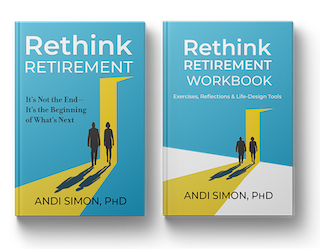
Rethink Retirement: It’s Not The End–It’s the Beginning of What’s Next
Out on Amazon and WalMart, and in your local bookseller and Rethink Retirement: The Workbook
Listen + Subscribe:
Available wherever you get your podcasts—Apple, Spotify, Stitcher, YouTube, and more. If you enjoyed this episode, leave a review and share with someone navigating their own leadership journey.
From Observation to Innovation,
CEO | Corporate Anthropologist | Author
Simonassociates.net
Info@simonassociates.net
@simonandi
LinkedIn
The complete text is:
Andi Simon 00:00:02 Welcome to On the Brink with Andi Simon. I’m Andi, and as you know, my job is to help you get off the brink. Now, for years, I’ve helped leaders and organizations rethink how they grow, adapt and change. Today, we’re turning that lens on something deeply personal and deeply cultural: Retirement. My new book is out. It’s called Rethink Retirement. It’s not the end, but the beginning of what’s next. And I’m going to start bringing people on to this podcast who are going to help you think about your own, either preparing for retirement or while you’re on the journey, because what we’ve discovered, both in researching the book and I can share with you what the 50 people told us and more, and what we’re learning as we’re doing our workshops and our master classes is that this isn’t simple. For decades, retirement was presented as the reward at the end of a long career. Work hard, save well, step away, you made it. And I must tell you, the number of people who celebrated it was extraordinary. And then they discovered what happens when stepping away doesn’t feel quite right. How? Well, what am I doing? Where am I going? Today people are living longer, healthier, and they’re more capable than ever. Many are quietly asking, who am I without my work? In our workshop, all three women said to me, who am I without my daily structure? Why do I matter and who do I matter to? What does this next chapter really feel like? How can I make it work better? I worked so hard to get here and I’m not sure I’m happy here, but on this podcast, we’re rethinking retirement not as an ending, but as a transition and a transformation, a reinvention. Pick the words that make it most sensible for you. It’s a moment of possibility and you’re in charge. This is a time when nobody’s going to structure your day. But what are you going to do when you wake up in the morning? As one friend of mine said, I get up in the morning, go to the gym, come back and have my coffee, and I have nothing to do. I planned this really well, but what am I doing? So each week I’ll be speaking with people who are redesigning their next chapter, sometimes intentionally, sometimes unexpectedly. Because retirement isn’t about stopping, it’s about choosing what’s next. So let’s begin. I want to introduce you today to a wonderful woman who has a chapter in our book. Her name is Mary Lou Mackin and Mary Lou we will call M.L. today. Has had a wonderful career in publishing. I’m going to let her tell you about it. You know, in my normal style, it comes out so much better than my reading a bio or a resume. So ML is going to tell you about her journey. She decided at 62 it was time to retire. And as she told us, she spoke with her husband, spoke with her financial planner. She was all set. And then what’s next? ML thank you so much for joining me today. I’m so delighted to speak with you and share your story. Please.
Mary Lou Mackin 00:03:05 Well thank you. So three years ago, I reached a point in my corporate career where I just hit a wall. I just one day literally snapped and said, I can’t. I just can’t do this anymore. It was a wonderful career. I worked with wonderful authors and a wonderful organization, but I was exhausted and I was depleted. So I did what I thought was the logical thing to do. Which was taken early retirement. and I did that. I did prepare myself and my company for this news, and I negotiated a stepped retirement. I worked part time for six months training the person who would be taking my job. And I thought I had everything figured out and there was a honeymoon period. No doubt of a wonderful summer, that I just did everything I dreamed of doing, including traveling and hosting friends. And anyway. And then it was as if, you know, the curtain came up and I was suddenly completely lost. It was rather dramatic and it precipitated a decline in my mental health. I’ll be honest, I kind of went down a dark hole and I felt like I was the only person on earth experiencing what I was experiencing. So now that I’m on the other side of it and I’ve met many people struggling with this same issue. I think to myself, boy, I wish someone had challenged me to think about a few things before I made that decision. And I wish someone had challenged me even just to say, are you really done? Or are you just done with this job? I think my situation was a classic case of burnout. Not a time that I was ready to completely stop. So it’s been a slow rebuilding process for me. But I’m happy to say I feel like I’m on the other side, and I want to do whatever I can to help other women coming behind me.
Andi Simon 00:05:48 Well, you know, and as I interviewed you and I looked through my notes, this has been a journey, with unexpected detours in it. Because you really thought that you hadn’t had enough, but you really didn’t understand. Now we’re going to start working with some of the companies to begin to prepare their employees better for retirement. But for the moment, nobody prepared you at all in your company for this.
Mary Lou Mackin 00:06:17 Not at.
Andi Simon 00:06:17 And you had a wonderful plan for exiting, but not for entering. There was no new. There was no practice. You had never done this before? So there are four themes that seem to have come through in the work that we’re doing, and I’ll share them in a general way and let’s talk about them. First is identity without my business card, who am I? The second is structure. How do I organize my day? Because while I think that freedom is what I’m looking for, I’m burned out when I have all this freedom. I’m not a very happy camper. The third one is purpose. Why do I matter and to whom and how do I find it? And the last one is community. Several of the folks in the book talked about how all their friends were in the office and they left the office. They weren’t their friends anymore and they didn’t realize they had no friends. So let’s go and sort of pick this apart a little bit for ML identity. You know, when you left and became part of the tribe, talk to us a little bit about how you began to redefine who I am?
Mary Lou Mackin 00:07:25 That was probably the hardest piece for me. And if you had asked me before I did this, do you identify strongly with your career? I probably would have said, no, I don’t think so. But boy, was I wrong. I’ve lived and breathed my work and everything that came with it, including constant interaction, intellectual challenge, travel. All those things I took for granted. and so who I was without that was I was lost. I entertained the idea of going and getting another job right away. And I interviewed for a couple things that were little different than what I had been doing. I took one job and six weeks in, I said to myself, oh my God, what am I doing? This is not what I want to do. Then there was a second job where I was not offered the position. And honestly, I can say it’s the first time in my career I’ve ever interviewed for a job in my life. So it was a little bit of a setback for me. But, you know, little by little, I sort of found a way and in part that was by connecting with other people, which ties into your community themes. Finding other people to talk to about this was tremendously helpful.
Andi Simon 00:09:02 And are there particular ways we can jump to the community? One doesn’t have to be last on all of this because I love it as a departure point. How do you begin to rebuild or find a community? I’ll give you an example. One of the women in the workshop said, I’ve traveled my entire career and now I’m back in a city and I have no friends. I don’t know where to begin. And another woman, similar to you, who had left her career, discovered that she had no friends outside of the business, and now she didn’t know where to begin. So how do you begin to build a community? It’s not easy.
Mary Lou Mackin 00:09:35 No, it’s not easy. a couple things. One is I belong to a gym. that is primarily women. and they range in age from probably mid 20s to 70s, maybe even 80s. And I made an intentional effort to say good morning and talk to people before and after class. That was very difficult for me, but I did. And in doing so, I’ve made a couple of new acquaintances that I can meet for coffee, or I can just have a chat in the parking lot afterwards. So that was a big help. I signed up for a free writing group at my public library, which met on, I think, Tuesdays at noon, which was great because that meant the people that were coming were also not working. So we have something in common. And, well, that was kind of challenging for me to write and share my work in a group setting. That’s just not something I’m comfortable with. It brought other things to me, including an enduring new friendship with the woman who taught the group. and she happens to live in my community, and she and I are good friends now. And, again, I sort of put my neck out there. And so that’s sort of how it started. And then I think the next contact was another, wonderful, wise woman named Andrea Moses, who I think you’re going to be talking to at another time, who was conducting a workshop online that I attended, and her story sounded so familiar, so similar to mine that I immediately reached out to her. Long story short, she needed to write a book. I was an editor. It was like our timing couldn’t have been better. Yeah. So she became a really good friend and online friend, but nonetheless so.
Andi Simon 00:11:47 Well, but you know, that gives us a community online and a community in person. And one, neither of which you had before.
Mary Lou Mackin 00:11:57 Correct. Correct. And I should add the meeting with Andrea also led to us creating a discussion group on luster for women who are struggling with their transition. And we have had a monthly Zoom call. I think it’s coming up to 9 months or so and it’s fascinating. Every month it’s a slightly different group, and people are out there and they’re looking for that connection. And if I had known that was out there when I was struggling, it would have been such a help. So. Yep.
Andi Simon 00:12:40 I think this is really an interesting, lifelong story about transformation. You’re not the same woman you were when you were in the office. What do you say to people at a cocktail party when they say hi, and what do you do? This was a recurring theme that I keep picking up on and my husband and I, who are not retired, neither of us are. We would be on trips and people would say, I’m retired. And I said, so do you do anything else? And are you anything else? Thoughts to share about how you identify yourself now.
Mary Lou Mackin 00:13:26 I’m pretty honest about when I meet people, say I left my career. I’m trying to figure out what retirement means to me. I mean, that’s my job. That’s my new job. Trying to sort it out. I still have good days and bad days still. But I feel like I want to open that door for people to talk about, even if it’s women who are not ready to retire, but it’s thinking about it. I have friends in that bucket and I’m constantly reminding them, please talk to me. Yes, or you do this.
Andi Simon 00:14:03 And we can send them the podcast so they can hear it as well.
Mary Lou Mackin 00:14:06 Exactly.
Andi Simon 00:14:07 Because you don’t know what you don’t know. And you’re bold and brave and courageous and that honeymoon year as a recurring theme in many of my interviews, I made it. And I’m doing all the things like you did. And then I don’t know what to do when I get up in the morning.
Mary Lou Mackin 00:14:23 Exactly, exactly. Yeah. That feeling of it’s, you know, Tuesday and it’s 10:00 in the morning and I’ve already gone to the gym and I have nothing else to do today.
Andi Simon 00:14:35 One woman said, I have nothing on the calendar for the rest of my life. And that calendar had been awfully booked. Now, let’s help our listeners think through as you’re going through this structuring your day, are you beginning to develop any clues or tricks or things that people should think about? Or is it still too soon to really think through? How am I going to get some order to this freedom?
Mary Lou Mackin 00:15:00 I think if I had been a little more intentional about what my plan was like, how would I structure a week? I know myself well that I’m a very structured person. I have always been a good student, you know, reliable, dependable, all those things. I guess I’ve thought I would just figure it out, and I, you know, I regret that I didn’t talk about it a little more or that, like I said before, that I wasn’t challenged by someone at my company or someone in my family or a good friend. I just know.
Andi Simon 00:15:44 And there was no role model.
Mary Lou Mackin 00:15:46 No role model.
Andi Simon 00:15:47 No mentors, no coaches. How Interesting. And just off we go into the foreign country. We can’t speak the language; we don’t know how to behave. And I’m going to have a good time.
Mary Lou Mackin 00:15:57 Exactly.
Andi Simon 00:15:58 Exactly the word purpose and why The Wall Street Journal had an article not too long ago about one of the biggest issues in retirement is why do you matter? And I knew you and I were talking a little bit about you starting to put together some thoughts about the next period of my purpose. Can you share a little bit about how your thinking is going? Because I do think that sharing the thought process is as important as the accomplishment. Your thoughts?
Mary Lou Mackin 00:16:26 Yes. Well, one thing I did was after a period of time, I kind of reconnected with my publishing network a little bit, and I started doing some freelance work for different publishers, some of it satisfying, some of it very unsatisfying. But it got me back in the mode of sitting down for 3 or 4 hours a day and focusing on something, which is all I want. Frankly, I don’t want to work 40, 50 hours anymore. But 15, 20, 25, that’s perfect for me. So I did that. And then, as I mentioned, I made this connection with Andrea and she needed help working on a book. And that took me in a different direction, because most of my publishing work was sort of on the education side of the publishing world. So this kind of brought me into a different realm and what I realized is not only do I have some expertise to share, but I have a tremendous network of people, many of whom are like me, sort of trying to figure out what to do after leaving their corporate careers behind. So I’m starting to formulate this idea of helping create some kind of an organization to support people in their third act or whatever we want to call it who want to write about their experience. I’m thinking about it. I’m hesitating a little bit because I don’t want to overstep. I don’t want to take on more than I want to take on. Yeah, but I’m kind of intrigued by this idea, so I’m sort of putting it out to the universe and thinking about it. And I’m probably going to, within the next month or two, start to kind of build a plan for myself and see how far I take it.
Andi Simon 00:18:34 Why not? I mean, nobody can tell you not to or to or you can detour or you can stop. I mean, the joy of having freedom is how to use it most wisely for whatever you’re defining as your reasons for happiness now. It’s very interesting. You are married, am I correct? And I just published a Substack on what happens when one spouse is married and the other is retired and the other isn’t. Yes. Your spouse retired.
Mary Lou Mackin 00:19:05 No he’s not. Although he has retired from his primary role. He’s working in a part time capacity, now probably four days a week, which I’m happy for him because I don’t want him to experience what I did. And we’re both very independent people. We certainly love each other’s company. But, you know, I’m not looking to spend every waking minute with him, and vice versa. But I will say, when I first hit that kind of wall, I was really missing him and wanting him to be around and resenting the fact that he got up and go to work every day. So if I’m honest, it was not easy at the beginning, and he was incredibly patient with me. And now we’re kind of in a different place. I think one of the reasons why I’m maybe limiting my set, my thinking a little bit is that at some point in the next few years, he’s probably going to make the big move. And then what does that mean for us? That’s a whole other chapter. So I still kind of feel like I’m in this in-between stage.
Andi Simon 00:20:22 You know, as I’m listening to you, the fellow I was telling you about who is struggling with his daily emptiness, but he planned his retirement. He really had it all mapped out where he was going, what he was doing, his trips he was going to take. He’s single. But he reminds me of having a life plan. Not just a financial plan. And as I’m listening to you, you’re making up. Could you have created this life plan ahead of time and what do you need to go through? I’m an experiential learner. I’m an anthropologist. If you cannot see it, you cannot be it. You really can’t imagine. There’s nobody to copy. It’s not as if there’s a community of wandering retirees and that you can hook up with your discovering. It’s not that easy to find like-minded folks. Thank goodness Lester is such a wonderful connecting place. But, you know, could you have built it into your own life plan? Would you advise people to try to or you’re sort of doing that with your husband a little bit, but you know, your thoughts?
Mary Lou Mackin 00:21:26 Yeah. If you know, theoretically, I think that would have been a wise thing to do. I think I was in denial or serious denial at that time, that it was going to be any kind of a problem. So I probably would have resisted a little bit. But I wish, I wish someone had at least posed a few questions for me to think about. Just put it in the back of my mind.
Andi Simon 00:21:51 Keeping your financial planner.
Mary Lou Mackin 00:21:52 Yes, exactly, exactly and it’s interesting because our financial planner, I told him about this book that I’ve been helping Andrea with and he said, My God, there’s such a need out there.
Andi Simon 00:22:06 We should give him our books, too.
Mary Lou Mackin 00:22:09 Yes, yes. I will do.
Andi Simon 00:22:10 That. And because the financial planners don’t have them, they’re not bad. They just don’t have an option to provide or any wisdom on how to. And they’re not going to go dip their feet in waters that they can’t even tell about. It’s interesting because this first book I put in as a series because I think there’s 3 or 4 books to follow. because the four pillars of this could each be a book on themselves, you know, how do you redefine your identity? How do you begin to build a structured day that has purpose and meaning for you? Where do you find one of the women in the workshop said, I have 18 things on my to-do list, but I don’t get anything done. ” And one of the questions we raised is who do you want to know? Who do you want to know? You matter. Because if you could focus on those kinds of questions, you won’t have 18. You’ll have 3 or 4, and you’ll be focused and really dedicated to building those kinds of relationships instead of being a scattered shotgun, hoping you can hit something. But, you know, to your point about everyone going through this individually without much process to it is really profound. And I think that there’s a really interesting time for us to help others get off the brink. And so, you know, we’re sort of at a point now you have less thoughts, things, some wisdom you’d like to share, anything that you think would be important for people like yourself who are living. I have some thoughts to add to your thoughts. But you know something that I don’t want to cut you off from? Something that’s going through your noodle. That’s real important to share out there.
Mary Lou Mackin 00:23:47 Well, I mean, you know, I think step one for me, probably in my recovery, if I want to call it that, was, being honest with myself and others about the reality that is difficult. I’m a prideful person, like most people. And, but I had to get vulnerable first. And I had to get honest about it. And that’s why I feel like now I want to put it out there so that other people don’t feel that sense of isolation that I felt. I really thought there was something wrong with me, that I had lost all my gifts because I suddenly didn’t, you know, know where to put them. I think that’s the first step, is just being honest with yourself and, and then, you know, you believing that somehow, someway there was going to be an end to this. There was going to be a way through this.
Andi Simon 00:25:05 As I read back over your section in our book, there were three lessons that your interview came up with. I’m going to share them with the listener. First is to do your homework. She wishes she asked more questions and prepared emotionally, not just financially. I think that’s what you’ve heard M.L. talk about today, because this is a transition out of work, but it’s also a personal transformation. Recognize the loss of structure. Absence of daily routine can create a void vital to plan ways to build a new routine and be honest about who you are. Work often forms a deep part of your identity. Anticipate the emotional impact. Now, this is so interesting because even in your interview, you continue to embrace the unknown of retirement, focusing on curiosity, community and craft. It’s not an end, but a challenge for the next stage. And that’s really cool. Now, one woman who told me that she was really happy in retirement had been a teacher, and another one who was a nurse, and they were so happy to be playing Mahjong every day. And I laughed and I said, you have found the antithesis to what you were and have no regrets whatsoever. And now they go pickleball where they have Mahjong games and they have lunch and that would not be me. It doesn’t say that would be you either. Yeah. No. And I don’t have a problem being me.
Mary Lou Mackin 00:26:34 No. No, I’m right there with you and me. I envy people who have this wonderful transition and are perfectly happy. No regrets. Yeah. boy. Sure would have been easier if that were the case, but that that just isn’t.
Andi Simon 00:26:55 That’s not your journey. And you are who you are. And you were very successful, and it was also very successful. Many of the folks who we were working with were very successful. And I’m not ready to make a generality, but their success almost provides a challenge when they leave it, because so much of who they were and what they did was tied up with it. Even if you got burned down, you know, it was a good time for a transition, but without a plan, it wasn’t such a good time.
Mary Lou Mackin 00:27:24 Yeah, I think that’s the key. I think the extent to which you identified with your work probably correlates to having a more challenging transition that comes. And I don’t know what it is that makes people identify or not identify with their work.
That’s kind of an interesting thing, I don’t know.
Andi Simon 00:27:51 Well, and the burnout doesn’t come from not being identified or being. Sometimes, you know, you’re ready for the next stage and we’re living so much longer. And that makes it a long next stage, doesn’t it?
Mary Lou Mackin 00:28:03 Right. It does.
Andi Simon 00:28:04 Right. I mean, we don’t know. But my father went to 100, so I got a lot of years to think through, you know, who am I and what am I doing? This has been absolutely charming, and I can’t thank you enough for sharing. Let me wrap us up and tell the listener that if you want to know a little bit more about M.L. Mackins story, it’s in our new book, Rethink Retirement. It’s not the end. It’s the beginning of what’s next. And you can see how she wove herself right into that book. Really well. but my thoughts as you think about today’s conversation, I want you to reflect on one major question. Where do you still want to matter? And I thought that Wall Street Journal article on matter is really at the essence of so much of what we talk about. You said important question. Not everybody relates to their work. It’s where they matter and where they have purpose. But for many, many folks, men and women, whether you’re running your own company and then sell it and have nothing to do, or you’ve had a very wonderful job and then leave it and have nothing to do, what? What does matter? Retirement isn’t about disappearing. It’s about choosing your next contribution. And I do think that what’s important is how you give. If this episode sparked something for you, share it. I’m forwarded to someone navigating their own transition. Join the growing Rethink Retirement Community because we need together to build a better next stage for each of us and all of us. This is not the end, it’s the beginning of what’s next. I’m Andi Simon. I’ll see you next time On the Brink with Andi Simon, we’re going to be talking to many more people who want to share with you their own journey. Give you some wisdom on how to experience this in a healthier fashion and anticipate what’s unknown. You need some role models and M.L. gave you that today, so I thank you. Any last thoughts on ML you’d like to share.
Mary Lou Mackin 00:30:03 I’m just delighted to be here and look forward to listening to your other episodes.
Andi Simon 00:30:09 Well, I’m glad because I think we could have a great time sharing all of this stuff with more men and women who are going to enjoy the journey with us. Thank you all. Thanks for coming. Remember, all of you listeners have made us ranked 18th among the top 100 podcasts on the topic of change. This is a wonderful next transition part to it. We’ll be doing more about business and changing you personally. And I’m really excited about Rethink Retirement and how it could help you get off the brink and soar. Bye. Now have a great day.