




How do ideas become movements? In this conversation with Bill Sherman, we explore why curiosity, expertise, and the willingness to share what you’ve learned are the foundations of true thought leadership.
What happens when your expertise becomes more than knowledge?
What happens when your ideas begin to change the way other people see the world?
That’s the fascinating conversation I recently had with Bill Sherman. Bill is the COO of Thought Leadership Leverage, lead author of The Thought Leadership Handbook, and co-host of the Leveraging Thought Leadership podcast — 700+ episodes on how ideas move into the world.
As a corporate anthropologist, I spend my career helping people and organizations see, feel, and think in new ways. Bill and I discovered that although our paths have been different, we share a common passion: helping people transform ideas into meaningful impact.
One of the insights that stayed with me from our conversation was Bill’s simple definition of thought leadership:
Thought leadership is about taking ideas to scale and creating impact—often without positional authority.
That is a powerful idea.
Many people believe thought leaders are simply authors, keynote speakers, consultants, or people with large social media followings. Bill challenged that assumption. Thought leadership isn’t about a title. It’s about curiosity. It’s about asking questions that won’t let go of you until you discover better answers—and then feeling compelled to share those answers with others.
I loved his observation that true thought leaders have a “spark in their eyes” when they talk about their ideas. Even after decades of studying a topic, they still enjoy explaining the basics to someone hearing them for the first time. Their enthusiasm never fades because their curiosity never ends.
As I listened, I found myself thinking about the many executives, entrepreneurs, physicians, engineers, and business owners I’ve worked with over the years. Many of them never considered themselves thought leaders. Yet they possess decades of experience, wisdom, and insight that others desperately need.
The question becomes:
What happens to that wisdom if it is never shared?
Our conversation also turned to artificial intelligence—a topic everyone is talking about today.
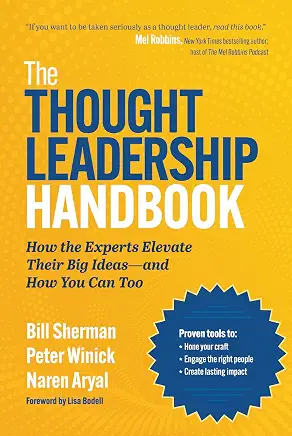
Check out his new book
Bill made an important distinction. AI is remarkably good at summarizing what has already been said. It can often provide an “80% answer.” But organizations and leaders still face questions that have never been answered before:
- How do we lead through uncertainty?
- How do we create cultures people want to belong to?
- How do we navigate difficult decisions?
- How do we prepare for a future that doesn’t yet exist?
Those answers require human judgment, imagination, and experience.
They require people willing to think beyond today’s accepted wisdom.
Perhaps my favorite moment came when Bill talked about retirement. Many people believe retirement means stepping away from contribution. Bill sees it differently. Some of the most effective thought leaders are people who have left their executive roles but are not finished making a difference. They no longer have positional authority, but they have something far more valuable: perspective.
That resonates deeply with the work we’re doing through Rethink Retirement.
For many professionals, the next chapter isn’t about slowing down. It’s about discovering a new way to contribute. Your title may disappear, but your expertise doesn’t. Your business card may be gone, but your ideas still matter. In fact, this may be the perfect time to write, teach, mentor, speak, coach—or simply begin sharing what you’ve learned over a lifetime.
As Bill reminded us, your ideas won’t speak for themselves.
You have to.
If you’ve ever wondered whether your experience has value beyond your current role—or whether there’s another chapter waiting to be written—I think you’ll enjoy this conversation.
Because sometimes the greatest legacy we leave isn’t the job we held.
It’s the ideas we leave behind.
Listen to the full episode of On the Brink with Andi Simon featuring Bill Sherman and discover why your next chapter may be the one where your ideas have their greatest impact.
Learn more about Bill Sherman: https://aha-moments.com/
Connect with me:
- Join my Substack Newsletter Rethink Retirement
- Website: www.simonassociates.net
- Book Website: www.andisimon.com
- Email: info@simonassociates.net
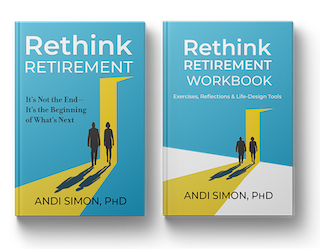
- Learn more about our books here:
Now–it is time to share our new book with you!
Rethink Retirement: It’s Not The End–It’s the Beginning of What’s Next
Out on Amazon and WalMart, and in your local bookseller and Rethink Retirement: The Workbook
Continue the Conversation
What does retirement mean to you?
I’d love to hear your thoughts. Share your experiences in the comments or join one of our Rethink Retirement webinars and workshops where we explore the questions that matter most—not just about your finances, but about the life you want to create.
Listen + Subscribe:
Available wherever you get your podcasts—Apple, Spotify, Stitcher, YouTube, and more. If you enjoyed this episode, leave a review and share with someone navigating their own leadership journey.
From Observation to Innovation,

CEO | Corporate Anthropologist | Author
Simonassociates.net
Info@simonassociates.net
@simonandi
LinkedIn
Read on for the entire conversation:
Andi Simon 00:00:02 Welcome to On the Brink with Andy Simon. Thanks for coming today. Whether you’re watching or you’re listening, it’s always a pleasure to bring you together with people who are going to help you do what I think is so important in these fast changing times. See, feel and think in new ways. My job is to get you off the brink. Remember, I’m a corporate anthropologist. My expertise is in helping organizations and the people inside them change. And you hate it. You hate me. People don’t want to change. But the times they are changing. And sometimes we need to really understand how to adapt ourselves and learn new things. So I have a wonderful gentleman with me today, Bill Sherman. And Bill has a new book coming out called Thought Leadership Handbook. We’re going to talk today about thought leaders. Now, I didn’t know I was a thought leader until one of the other authors, Peter Winick invited us during the pandemic to join a group of thought leaders, and it’s a wonderful group of people who really are taking ideas and turning them into different kinds of implementation, influencing others, helping businesses see things through a fresh lens, the kind of work I like to do.
Andi Simon 00:01:20 But there’s a difference between being a consultant, a coach, a thought leader, and they’re all different categories. So Bill, thanks for joining me today.
Bill Sherman 00:01:29 Happy to be here, Andy.
Andi Simon 00:01:31 Let me tell you a little bit about Bill. I’ll read you a little bit about his bio, and we’ll talk about his journey. But most of all, I want to talk about this evolution of thought leadership. And in a world of AI, a little bit, but not a lot, but really about how does a person help others influence where they’re going with the wisdom you might need in order to see things through a fresh lens? So who’s Bill Sherman? bill is one of the leading voices in the growing field of thought leadership. He’s chief operating officer of thought leadership leverage, and he spent more than two decades helping executives, entrepreneurs, authors and organizations transform their expertise into ideas that shape industries and influence change. He has worked with fortune 500 leaders, thinkers 50 recipients. New York Times bestselling authors and emerging experts to help them really codify, scale, and amplify their intellectual capital.
Andi Simon 00:02:30 So this is very interesting today. He’s also the co-host of the award winning Leverage Thought Leadership podcast, where he and Peter Winick have interviewed hundreds of today’s leading thinkers about how ideas become movements and expertise becomes impact. Their conversation and years of consulting have now been distilled into this new book; The Thought Leadership Handbook How the Experts elevate their big ideas and how you can too. Now today we’re going to talk about this topic. What is thought leadership? What does it really mean? Why expertise alone isn’t enough, and how leaders can transform knowledge into influence that creates meaningful change. Even after you retire from your current position. And what comes next might be an interesting thought for you, my great audience, to think about it. So let’s begin. Bill, thanks for joining me. Tell the audience, who is Bill Sherman? What’s your journey been?
Multiple Speakers 00:03:33 So let’s see. I thought I was going to be an academic and many years studied for a PhD in English literature, and I wound up leaving just before comprehensive exams fell into the world of corporate and started learning and development moved to organizational development of how to get the right people to do the right thing at the right time, make sure they’re rewarded for it, and you take the roadblocks out of their way.
Multiple Speakers 00:04:06 So you were from the corporate anthropology perspective. I was from the organizational development perspective. Right. But akin, I think, and one of the questions at that time is even when I was doing organizational development, how do people create impact? How do leaders create impact through others? And leaders typically have positional authority. They have a team. They have resources. They can allocate budget, they can allocate, you know, partnerships. But what happens when you don’t have the positional authority when you have a good idea? And the way that I’ve stumbled into thought total leadership, and I would say 100% that I stumbled into the field of thought leadership was I was doing project work and organizational development, and I had a C level executive who had written a business book. It got on the cover of Fast Company back when Fast Company was one of those print magazines you needed to have a copy of each month, right?
Andi Simon 00:05:18 I remember those.
Multiple Speakers 00:05:20 Exactly, so do I. And the conversation began. Bill, you knew how to make impact within organizations.
Multiple Speakers 00:05:27 How would you take the ideas from the book and make them accessible to others? That’s how I stumbled into thought leadership. Oh, 22 years ago.
Andi Simon 00:05:39 So you fell into it by chance? It’s so interesting. So many of the podcasts I’m doing these days is about serendipity. It’s about chance, not by design. Not that you really know where we’re going, but somehow somebody says something to you. I said a wonderful way of discovering who you are, isn’t it? It wasn’t what you were going to do. You fell into something that spoke to you in terms of, oh, this is who I am. I can do this, can’t I? So how did it all develop from there?
Multiple Speakers 00:06:12 Yes. So let me take a step.
Multiple Speakers 00:06:14 Farther back to go forward. So I’m the son of a librarian. And so I’ve always been bookish, and I think that was one of the reasons why I spent as much time as a graduate student as I did. And I still love books. But after that first client that I had who was the fortune 500 exec, I would get calls from other executives who say, who would reach out to me and say, hey, Bill, I hear I should talk to you.
Multiple Speakers 00:06:49 My friend so-and-so referred you, right? And so I had this side practice alongside organizational development, where I was helping people who had written a business book look at how did they take the ideas to scale. One of them was a chief marketing officer for both Deloitte and then Starwood Hotels. Keith Frazee, he’d written a business book, Never Eat Alone, and he’d sold very quickly nearly half a million copies. Right. It was a thing Keith never expected that he would be writing a book around relationship building and networking. And in fact, his response was, I never wanted to be the networking guy. Right. So the book that he had didn’t necessarily describe how to do what he did. But organizations were asking, hey, how do we give our salespeople? How do we give this team or that team some of what Keith is able to do naturally, right? And so reverse engineering a book that had already been written and try to figure out how to make it accessible, how to create impact through it.
Multiple Speakers 00:08:13 And that led me really into the world of ongoing thought leadership consulting. 2013 Peter Winick and I, Peter and I had worked together with Keith Rozzi. We joined together. We run thought leadership leverage, and we work with people at every step of the thought leadership journey, I would say from emerging thought leaders, maybe they’ve written their first article, given their first talk, or they’re thinking that may be their next act. You know, after they retire or they have a break between roles might be thought leadership. Or maybe they’re looking for another challenge to layer on to their current role. Or we had one client who’s CEO. He was chief medical officer. His CEO wandered down the hall, popped his head in and said, hey, Craig, I think, I think you should write a book. And then wandered off before Craig could get out around his desk and go. Are you serious? The CEO had disappeared down the hall and was gone, and so he had a period of about two weeks where he was like, am I writing a book or not? So we waited.
Multiple Speakers 00:09:28 Then in the next, C-level meeting, the CEO asked Craig, hey, how’s the book coming? He’s like, oh, I guess that is an action item, right?
Andi Simon 00:09:41 Well, Now. I love your journey of discovery. And the stories. Remember, are they make it come alive. But let’s talk about what exactly is this thing called thought leadership? Somebody wrote a book, and now we’re going to turn it into making the ideas accessible, livable, actionable. We’re going to turn it into something that influences the way a company or a person migrates or operates in some way. I remember the book Never Eat Alone. It was a classic. There are many like that which became actionable because they were more than just a book. They were really a way of influencing the way you were doing things. Help us.
Multiple Speakers 00:10:21 And many of them.
Multiple Speakers 00:10:22 Actually, they catch the zeitgeist of the time. Yes. Right. And you lean in and you’re like, oh, this is the book I need for now.
Multiple Speakers 00:10:31 Yeah, right. Yep, yep. And there’s some that wind up being eternal. I mean, if you could look back, people still read How to Win friends and influence others. And that book is almost 100 years old.
Andi Simon 00:10:45 Yep.
Multiple Speakers 00:10:46 Yep.
Andi Simon 00:10:47 Well, none of ours. you know, I’m on my fourth book, so I appreciate what you’re saying. I hope it’s around in 100 years. But this is important because I call myself a corporate anthropologist. I do a tremendous amount of consulting. I’m an executive coach and been trained. Yep. I didn’t know I was a thought leader. And so that becomes a, you know, a question of who what is that something someone defines me as or something I create myself. Help us.
Multiple Speakers 00:11:17 So.
Multiple Speakers 00:11:18 Thought leader, there’s a lot of people who will tell you it’s a buzzword, it’s jargon. It’s for people with big egos who want to be seen. They put it on their LinkedIn profile, beat their chest and say, I’m a thought leader.
Multiple Speakers 00:11:32 Follow me. Right.
Multiple Speakers 00:11:35 I take a.
Multiple Speakers 00:11:36 Different perspective on that and we can dig into it. Thought leadership for me is about taking ideas to scale and creating impact through them, often without positional authority, often without any obligation to do so. I mentioned Craig earlier where his CEO said you should write a book, but he’d been practicing thought leadership, speaking and writing short form articles long before the book. Where it begins, I think for an individual and it becomes a mindset that leads to a practice. Okay, is it starts with curiosity. Often people have a question burning inside of them. They want to know an answer to. Maybe it’s an issue they struggle with, or maybe they’ve seen their organizations struggle with or clients struggle with. And they say, how does this work? I want to understand it so that I can be better, my organization can be better. My. I can help my coaching clients, my consulting clients, whatever. Right. So it begins with curiosity that almost borders on the level of obsession, right? Some people might spend an hour to getting lost in Wikipedia, or reading an article or two, or a book and say, okay, I’ve learned enough and done right.
Multiple Speakers 00:13:10 The people who practice thought leadership have a certain tell, if you will like. At the poker table, there are tells you know, is the person bluffing? Do they have a strong hand? What I look for in thought leadership is did they have a spark in the eye? Do they light up vocally nonverbally when they talk about the idea? Because I have a rule that no one will ever be more interested in your ideas than you are, right? And those people who practice thought leadership wind up getting immersed in the idea. Loving it. Digging deep. And then. And here’s the magic. Even if they studied it for 30 years, they’re happy to explain the 101 entry level basics to a new audience for the first time, with the same level of joy. Right. Wow. Even if they’ve flown halfway around the world. Lisa O’Dell, who wrote the foreword for our book, describes how she left New York, flew to Greece, was on the ground for about eight hours, which was enough time to get through customs, get changed, deliver a keynote, And then get back to the airport.
Multiple Speakers 00:14:36 Okay. And then she flew from Greece and Athens to Miami to do it again before getting home. And the question becomes, okay, you can make a good living as a keynote speaker or a coach or a consultant. But at some point, the miles wear you down. Why do people spend such a percentage of their time talking to strangers and sharing ideas? And it’s the curiosity, the passion and the willingness to share, which are the mindsets. And so if I hear someone say they’re a thought leader, but I don’t see the spark in the eye, the energy and the voice or the willingness to sit down, even if they’re an undergraduate college student just asking questions, I’m like, you’re going to get tired of that topic, you’re not going to want to talk about it for 30 years.
Andi Simon 00:15:36 Interesting. So this is all quite fascinating because in some ways I accepted the nomenclature. I speak, but I never thought of myself in a fashion different than who I am and what I love to do.
Andi Simon 00:15:54 But it is a really interesting idea where the joy is inside that you want to then share. And so this is all about your own passion and purpose with it and what you want to help others because you know something you think could be of help to them. I, I’m, I’m curious about curiosity. In an age of AI, you have some more thoughts about whether people are going to be turning to AI instead of to those influential influencers, thought leaders. I mean, can they find the answer easily or faster or differently?
Multiple Speakers 00:16:30 Yeah.
Multiple Speakers 00:16:30 So let’s take a look at what’s happened so far and what’s likely to happen. People used to pre-internet rely on trusted gatekeepers for information. We listen to authorities printing and publishing. Even though the printing press expanded, access to knowledge, you know, was still gated through the late 20th century. Now you can self-publish a book. You can record a YouTube video and layer on to that AI, where it will take and consume most of the world’s knowledge and give you an 80% answer most of the time.
Multiple Speakers 00:17:11 And for most of us, many days, where do I go to dinner? Who’s a trusted tailor? Those questions my life isn’t going to be transformed around. Generally, an 80% answer is good enough. Yeah, but if I’m trying to shape my life and make tough decisions. If I’m trying to make decisions for the business that I’m leading, or if I’m also trying to keep the business ahead and look forward, well, then you have this question. Do you trust a system which is a predictive engine based on what has been said before? Yeah. Or do you turn to experts who are looking ahead into the future? I’d argue that because it’s become easier for individuals to put repetitive content out there, it becomes essential because the public square just gets noisier. Yeah, right. If experts who have little t truth not big T truth, not the meaning of life. Not is there a God? What’s the meaning of the universe? Leave that to the philosophers and to the theologians. Little teachers. How do I have a difficult conversation with someone about performance at work? What is our culture and where are we going as a team, as an organization? Those are questions where there’s not a deterministic or predictive answer.
Multiple Speakers 00:18:51 You have to find it from looking within and working with experts. So in terms of thought leadership, there are plenty of coaches, consultants, authors and many different flavors of people who practice thought leadership. One of the things that Peter and I noticed and I was actually here, we had a gathering of thought leadership practitioners, or at least we saw them that way. back in 2019 here in Las Vegas. and we were doing some video recording together with them. And then we were doing a dinner. And one of the things that I realized was we had a consultant, we had a keynote speaker writing her first book. We had someone who had written a dozen business books. We had a CEO who’d written a book because they wanted to grow their business, and we had an expert who knew the secret Sorcerer’s company in a way that nobody else could describe. And what struck me was they were all practicing thought leadership, and you could label them as author, coach, consultant, speaker. But what was much more important was the why.
Multiple Speakers 00:20:14 Why were they practicing thought leadership? Was it to grow their business? Was it because they were retired or planning on retiring, and they wanted to stay engaged to share what they had learned, and maybe they weren’t ready to ride out into the sunset. Those the impact and legacy executives who being on the board or playing golf wasn’t enough. Thought leadership was a choice they made for their retirement. Then there were the thought leaders on the run who had to be in the room or the zoom to create value. The in-house experts who, like I mentioned Craig earlier, got tapped by their CEO and said, go practice thought leadership. Advocate not only for the organization but build a personal brand. And then finally, the Hall of Fame experts who, not all of them were looking at the end of their career or the end of their life in some cases. And I can tell a story on that. But the Hall of Fame experts are asking the question, how do these ideas continue and persist even after I’m gone? And we saw those patterns not only at the dinner table, but more importantly, through the 700 podcast interviews we did with practitioners from the emerging, the established and the expert thought leader.
Multiple Speakers 00:21:41 All of them. The why they practiced thought leadership was far more important than how. Right.
Andi Simon 00:21:49 So is your thought leadership handbook about how people can take their why and turn it into a how or give us a little sort of synopsis of what if you put together there.
Multiple Speakers 00:22:00 So a couple things. I’ll give you some of the core ideas and then brief tease into structure. First off, I strongly believe that ideas cannot speak for themselves. However, you can write. The second is expertise in your field is not the same as expertise in the skills of thought leadership. However, you can learn both. You can be an expert engineer. You can be an expert negotiator and make a good living in life. But that level of advocacy for the idea, beyond just how you live your life, becomes transformative, right? Do you show others the way forward? Okay. And then the third core idea I would say that’s covered in the book is you have a duty to speak those little t imperfect truths.
Multiple Speakers 00:23:00 And no, they’re not going to answer all the questions in the universe, but they may make a Tuesday afternoon for someone in a meeting under a cognitive load a lot easier if they have your idea, right. You have a duty to speak imperfect truths, but you have no right to an audience. You have to earn it. So if thought leadership.
Multiple Speakers 00:23:21 Is.
Multiple Speakers 00:23:22 A discipline, a field and a set of skills, how do as I as a practitioner answer questions like is my thought leadership any good? How do I make it better? And is it landing the way I wanted it to land? Those are questions that drive the four elements of thought leadership. Then the other question that we’ve heard from clients as well as our podcast guests, is how do I create more impact? I thought I had a great idea. I thought it would take the world by storm and it’s not okay, but I want I wanted to go further. I wanted to be able to travel without me. Well, how does impact work? That’s the impact equation, which is another section of the book.
Multiple Speakers 00:24:09 Then we go into the five avatars. We tell stories based on the podcast, interviews of moments of struggle, success, fear, vulnerability, accomplishment. And one of the wonderful things about the podcast is our guests share those moments, the moment when they were afraid to press send. Before asking clients, can I interview you for my book? That moment of abject terror. Those moments become real. And then the last part of the book is a handbook for all of the questions that I just asked, and more. There are tools to guide you through step by step on those now. Is it the same as if you wanted to work with Peter Winick and me? No. Obviously I can’t put everything in the book, but I felt it was important to take the knowledge which had been, quite honestly, I’d kept it behind a consulting paywall and put it into the public space to have a conversation. Because if thought leadership is going to be more than a punchline, if it’s a skill that’s going to make transformation in the age of AI.
Multiple Speakers 00:25:26 If it’s a field worthy of study and rigorous study, I tried to teach and treat the writing of this book from an ethnographic perspective, not only telling other people’s stories, but then bringing them back to them and saying, did I get it right? Does this ring true for you? And so in many ways, we have 60 people whose stories are in the book, and then others who 50 others who have spoken in support of it. This is a book that’s deeply woven into the community’s experience of practicing thought leadership at every step of the journey and more importantly, a call to we can do this better.
Andi Simon 00:26:11 Yeah, I love the idea that, thought leadership is in its own evolution as the times they are changing. So is the ability of people to take ideas and help you see feeling, think differently about them so you can do better. And it has to come through in many ways, the voice of the owner of the idea, as well as the other tools that they have. It isn’t a one and done.
Andi Simon 00:26:39 It’s a real integrated approach to helping people do better. So as we’re looking at our time, I’d love you to end with one, 2 or 3 things. You want to make sure that our listener or viewer doesn’t forget. And then how do they find your book and perhaps reach you? Sure.
Multiple Speakers 00:27:00 So let me circle back to.
Multiple Speakers 00:27:02 The impetus for the book, which is ideas can’t speak for themselves. You can. We’ve seen a number of people ranging from Ivy League professors, fortune 500 C-level execs ask the question, are my ideas good enough? Right? Or am I the right person for this? There are other books on leadership. Does the world need another book on leadership? And here’s my answer on that. Thought leadership has two barriers to entry beyond quality of idea. One, a lot of people don’t enter thought leadership who should because they have imposter syndrome. They don’t feel good enough. Second, many people experience content insecurity. Are my ideas good enough? Are they worthy to be in the room? Will this play for this audience? you have to be willing to take risk to practice thought leadership.
Multiple Speakers 00:28:15 99.9 some percent of the world won’t care about your ideas. I don’t know how to be deeply relevant to 8.5 billion people, but if you narrow that down and you say, I’m going to be relevant to this thousand chief medical officers in North America.
Multiple Speakers 00:28:37 That becomes a manageable number.
Multiple Speakers 00:28:39 You can start engaging with them. You can shape a conversation, you can advance a conversation, and you can be someone that others turn to. And in the age where. It’s easy just to go on LinkedIn and post what others have posted. Yeah, people who are leading the conversation are absolutely necessary. The thought Leadership Handbook comes out on July 21st, 2026. As you listen to this. It may already be out. You can find it at Amazon Bookshop as well as Apple and Google. So the Thought Leadership Handbook. And if you’re interested in following me, you can find me at Bill Scherman moments on LinkedIn. Or you can visit. Thought leadership leverage, which is where I work.
Andi Simon 00:29:45 And we’ll have that all up on the show notes and the, on the YouTube video.
Andi Simon 00:29:50 Because this has been a charming and fascinating conversation with Bill Sherman. I brought you Bill Sherman today because not only does he have a new book out, but it’s also his first book. I’m with Peter Winick. They have written a book that’s going to help you begin to see yourself. maybe in a new way. And I have a hunch there are some folks out there who have been noodling around with the idea. Either I can write a book, and if I wrote a book, what do I do with it? How do my ideas really take on traction? What is my purpose? Why do I matter? And these are real, important questions as you think about this idea of being a thought leader, where your ideas become influential in how others live their lives, run their business, deal with their clients, do things that matter in a fast changing time. And this is the piece that’s so important. When times are changing, the old may still work, but in fact, you may need some fresh perspectives and you’re not going to necessarily get them just by asking AI, you may have to really hear it from a human.
Andi Simon 00:30:59 Don’t let the curiosity factor the questions you’re asking disappear because there are answers and people who can help you answer them and give you inspiration to actually take action. Bill has been so much fun. Thank you so much for coming today. I truly appreciate it.
Multiple Speakers 00:31:15 Thank you Andy. It’s been a lot of fun.
Andi Simon 00:31:17 Good. Now for all of you who have made On the Brink with Andy Simon among the top. Oh, I think we were ranked 13th among the top 100 podcasts on the topic of change. Thank you. You also send me great notes at info at Andy Simon, and I get all kinds of feedback that helped me find new people to help you do as an anthropologist might see, feel and think in new ways because at the end of the day, the times they are changing and your brain hates it. And me because it doesn’t want to change. But it can. But it has to become curious enough to see what’s out there. So the books, all four of my books now are on Amazon under Andy Simon, Andy Simon.
Andi Simon 00:31:59 Com talks about our workshops, our masterclass and our two day retreat, and I’m anxious to hear how you are beginning to adapt some of this to your own business or to your life. If you’re thinking about the next chapter, what’s next? you know, rethink retirement. Our fourth book is about exactly that. And in it, our 30 stories of people who have done a wonderful job of changing their lives as they left. What work was moved into this next stage? Not easy, but a great time. Some of the folks who retire become thought leaders. They don’t want their ideas to go in. You can too. So thanks for joining us today. Stay happy. Please don’t forget to take your observations and turn them into innovations. It’s extremely important today, and it’s time for you perhaps to think about Thought Leadership Handbook, Bill Sherman and how you can get the help you need to become the person you would like to be. Thanks again. Thanks again. Bill. It’s been a pleasure. Bye now.
Multiple Speakers 00:32:59 Thanks, Andy.