



What Sets Humans Apart? Key lessons from my conversation with Dr. Robin Hills
.As artificial intelligence accelerates and reshapes how we work, learn, and communicate, one question keeps resurfacing: What remains uniquely human?
That was at the heart of my recent On the Brink conversation with Dr. Robin Hills, a business psychologist and one of the world’s leading voices on emotional intelligence. Our discussion offered both reassurance and challenge—especially for leaders navigating rapid change, generational shifts, and technology-driven uncertainty.
Here are the key lessons that stood out.
1. Emotional intelligence is not “soft”—it is foundational
Emotional intelligence (EI) is often mislabeled as a soft skill. In reality, it is a core operating system for effective leadership, collaboration, and decision-making. As Robin explained, EI is about being smart with your feelings—integrating emotion and cognition to respond thoughtfully rather than react impulsively. This matters because emotions are not optional. They are physiological and psychological responses to our environment. The choice is not whether emotions will influence us, but whether we will learn to work with them skillfully.
2. Self-regulation is becoming a critical leadership skill
One of the most striking themes was self-regulation—our ability to pause, choose, and respond intentionally. In a world of constant notifications, endless information, and emotional triggers, self-regulation is increasingly difficult and increasingly essential.
Robin highlighted how our attachment to devices can undermine emotional awareness, presence, and learning. When leaders (and teams) cannot disengage long enough to listen, reflect, or engage meaningfully, they lose both insight and connection. Mastering technology rather than being mastered by it is now part of emotional intelligence.
3. Emotional intelligence must be learned—and relearned
We often assume people “pick up” emotional skills naturally. Yet many do not. Education systems may introduce emotional awareness early, but rarely sustain it through adolescence, higher education, or professional life.
The pandemic amplified this gap. Younger generations lost critical years of social learning, while adults themselves were stretched emotionally. Rather than blaming or labeling behaviors, the opportunity now is to rebuild emotional skills deliberately—in schools, workplaces, and leadership development programs.
4. AI will not replace what makes us human
Despite growing fears about artificial intelligence, Robin was clear: AI does not have emotions, empathy, purpose, or meaning. It cannot truly collaborate, lead, or innovate in the human sense.
What AI can do is free us from routine tasks—making our emotional and relational capabilities even more valuable. Creativity, empathy, ethical judgment, perspective-taking, and meaning-making are not threatened by AI; they are highlighted by it.
The more technology advances, the more human skills matter.
5. Emotional intelligence gives us choice
Perhaps the most powerful insight was this: emotional intelligence gives us choice. Choice in how we respond under pressure. Choice in how we communicate across differences. Choice in how we turn uncertainty into opportunity rather than fear.
We will not get it right every time. As Robin noted, if you respond well eight times out of ten, you are doing well. The work is learning from the other two—without self-criticism, and with curiosity.
A final reflection
As an anthropologist, I see emotional intelligence as part of how humans adapt. Our brains may resist change, but our capacity to learn, empathize, and create meaning has allowed us to thrive across millennia.
In a world reshaped by AI, emotional intelligence is not a “nice to have.” It is how we remain human, relevant, and resilient—at work and in life.
If this conversation sparked new ways of seeing, feeling, or thinking, that is exactly the point.
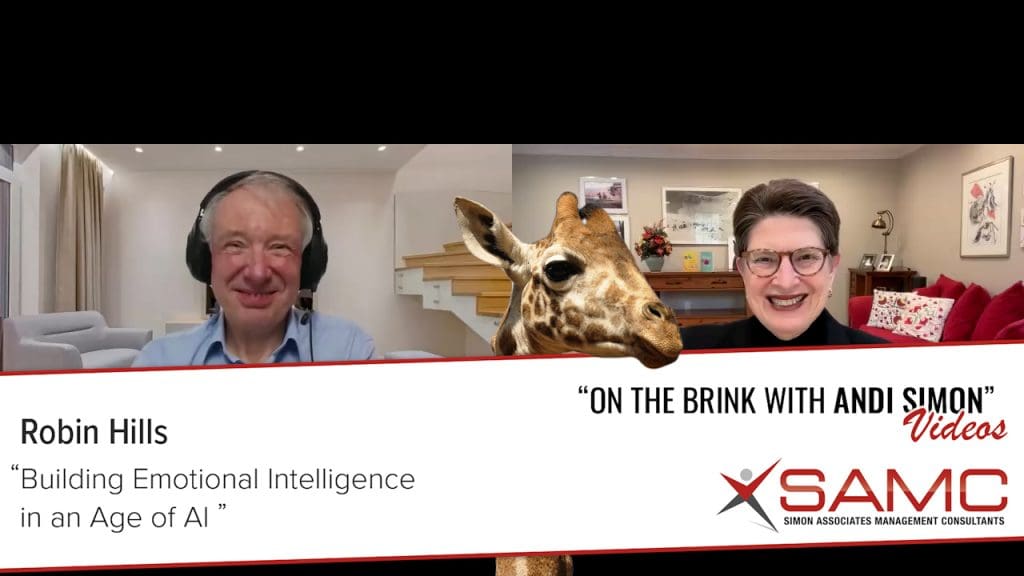
Watch our podcast interview here:
Connect with Robin Hills:
On LinkedIn: https://www.linkedin.com/in/robinhills/
On his websites:
- ei4change.com/ (Personal)
- courses.ei4change.info (Company)
- ei4change.com/resources/ (Other)
Connect with me:
Watch for our new book, Rethink Retirement: It’s Not The End–It’s the Beginning of What’s Next. Due out Spring 2026.
Listen + Subscribe:
Available wherever you get your podcasts—Apple, Spotify, Stitcher, YouTube, and more. If you enjoyed this episode, leave a review and share with someone navigating their own leadership journey.
From Observation to Innovation,

CEO | Corporate Anthropologist | Author
Simonassociates.net
Info@simonassociates.net
@simonandi
LinkedIn
Here is the full text of our podcast:
Andi Simon: 00:00:02 Welcome to On the Brink with Andy Simon, a podcast that’s designed and dedicated to help you see, feel and think in new ways so that you can adapt to these very fast changing times. I’m Andy Simon and as you know, I’m your host and your guide, and I find people or they find us to tell stories for you about new ways of thinking or doing so that you can grow. Now, remember, the research is really compelling. The more ideas you have, the more likely you will have good ones, big ones, and they come at the intersections. But the only way you get new ideas is to listen carefully. Hear what people are saying and begin to understand how to apply it for your own life experiences. So whoever you are, an entrepreneur, mid-market, a CEO, it doesn’t matter if you’re doing this for your personal growth. As I know so many of you are. I have today with me a wonderful individual Robin Hills came to us from the UK. And that background that you’re seeing if you’re watching this isn’t necessarily real, but it is very real if you travel around England, Scotland, Wales.
Andi Simon: 00:01:12 It’s a beautiful background. Robin, thank you for joining me today.
Dr. Robin Hills: 00:01:16 Oh, Andy, thank you so much for having me on your show. It’s a pleasure to be here.
Andi Simon: 00:01:21 Let me tell the audience about who you are, and then you will tell them about your own journey, because it’s such fun to think about how your journey has taken you to where we are today. Doctor Hills is a highly esteemed business psychologist and a director of E AI for change. I think e AI means emotional intelligence for change because he’s quite an expert. And for all of my Leadership Academy folks, we really talk a lot about EQ and E AI and what it means and how do you develop it. But what is it really? And how can Doctor Hills show you more or tell you more? So you can really embrace it better at Eve for E.I. For Change is a company specializing in educational training, coaching and personal development focused on emotional intelligence, positive psychology and neuroscience. And I must say that I’m an even though I’m an anthropologist, I love reading about what the neuroscientists are beginning to understand about our brain.
Andi Simon: 00:02:23 And there’s a marvelous Scientific American arm journal that came out last week about all of what the neurosciences are teaching us about. Each brain is unique, and it’s also very weird. So we’ve got a wonderful brain for us to think about. Today, I for change was awarded the International Impact Company of the year award by Dotcom magazine in 2024, which is a marvelous honor, and that’s why it’s so wonderful to have Doctor Hill’s with us. With the most comprehensive and detailed courses around the topic of emotional intelligence, Robin has taught and empowered more than 400,000 people across 195 countries. He is an accomplished author and keynote speaker. He’s spoken at Harvard, among other places. He’s awarded the Best Transformative Emotional Intelligence Coach of the year 2024 by the CIO, times and men leaders to look up to by passion Vista magazine. Early in 2024, Robin was awarded an honorary doctorate and Advanced Studies at in psychology and recognition of his contribution to the emotional intelligence training. We’re going to talk a lot about a lot of things today that is going to be very interesting, insightful, provocative, and as you think about your own emotional intelligence.
Andi Simon: 00:03:40 Listen carefully to what he is going to provide for us in our 30 minute podcasts. Robin, thank you for coming.
Dr. Robin Hills: 00:03:49 Well, thank you. When you read all that out, I thought, is that really me? Well, yes, I suppose it is, isn’t it?
Andi Simon: 00:03:55 Well, we’re going to talk today about AI in a Changing World. And what Robin and I were talking about before we started is what will emotional intelligence mean in a world of ChatGPT? Although I must tell you, as I talked to chat, I talked to it and I thank it. And I say please and thank you. And it responds, it’s a real interesting, non-human humanoid. Robin, who are you? What’s your journey been like? Share it with our listeners.
Dr. Robin Hills: 00:04:19 Yeah, I will be very, very brief because I don’t find my journey particularly interesting, although I’m sure your listeners will find it fascinating. When I graduated with a degree in biology, who at the latter end of last century, I wanted to do something that utilized my degree but wanted to do something completely different.
Dr. Robin Hills: 00:04:40 So I went into the pharmaceutical industry, into medical selling, and I did that for many, many, many years working in the teaching hospitals of London. And I found it absolutely fascinating that in order to be successful, doctors had to use their emotional intelligence. And in order for me to be successful, I had to use my emotional intelligence. And there were some doctors that were not, and still not very emotionally intelligent, yet have a degree of success because of their cognitive abilities. Now, through a series of job changes, job roles, organizational changes and redundancies, I ended up in this century thinking to myself, I need to do something a little bit more constructive with what I’ve learnt and how I’ve learnt it. And so I moved into, setting up my own business. And as most people have been told, when they set up in business that you’re not a jack of all trades and master of none, you need to specialize in something. So in terms of people development, I thought I would specialize in this up and coming area of emotional intelligence.
Dr. Robin Hills: 00:05:59 It had been around at the time, about 15 years, but it still wasn’t well known, and it still wasn’t well recognized. So having found that unique niche or niche or however you pronounce it, and I see a and I see he, I decided to focus in on emotional intelligence. And I’ve had a wonderful time ever since going all over the world. And indeed, Andy, getting to know personally some of your guests prior to both of us even knowing that On the Brink existed.
Andi Simon: 00:06:38 Well, it is six degrees of separation, and the world is remarkably small, but everybody is really trying to share their own wisdoms and to help others. The podcast has become a fabulous medium for doing that, because it doesn’t require a whole lot of anything other than come and tell a story that people can really resonate with and learn from. So, you know, while you’ve done it for 400,000 people, here’s a whole lot more ready for your wisdom. So as you began to grow, I for business change for change.
Andi Simon: 00:07:14 how did it mature? What did you learn as you began to do this so that it now is at a very important, I think, critical point where the world is changing and how are our emotions also going to be and share a little bit.
Dr. Robin Hills: 00:07:28 Sure, sure. Oh, there’s a lot within that question. But just to keep it very, very simple and straightforward, really emotions underpin everything that we do. They are psychological and physiological reactions to the environment that we find ourselves in. So, how did I establish myself in the field of emotional intelligence? Well, about ten years ago, I saw the opportunity to put a number of courses online based around emotional intelligence, giving people the practical instructions around how they can apply emotional intelligence in the workplace. And because I was a little bit of a pioneer and an entrepreneur at the time, a lot of people were not understanding what I did. And it was starting to come to a really good level of fruition prior to the pandemic. And then, of course, as soon as lockdown came along, everybody wanted to learn and self-develop and utilize their time effectively.
Dr. Robin Hills: 00:08:40 Now I was in the right place at the right time with the right products and my business increased phenomenally. And the number that you’ve quoted is unfortunately. Well, no, no, that’s the wrong word. Fortunately, it’s out of date. We can add another 100,000 people to that number, and we can add a few more countries to that number. So emotional intelligence now has become recognized as very much a, a cause for good and important part of business.
Andi Simon: 00:09:18 Well, you said something important. And, as you catch your breath, think about it. What is emotional intelligence? I know you said we have emotions. They’re physical. Physiological. I often tell people we buy with the eyes and the heart and how things feel before we even think about them. and to be intelligent about those emotions and how to use the right ones at the right time, how to walk away from things and control them and give us a bit of perspective, without divulging your entire course, but what is it you mean by being intelligent Emotionally.
Dr. Robin Hills: 00:09:56 I think you’ve actually summed it up within your question. And also, I think the strapline that you’ve got for On the Brink works really well. It’s about seeing, thinking and feeling. So emotional intelligence is about being smart with your feelings. It’s the way in which you apply your intelligence to your emotions. and it’s combining your thinking with your feelings in order to make good quality decisions and build up authentic relationships with the intention of taking action, and to do so in an appropriate way. So, it’s a lot about understanding your emotional state and working with that and remembering that you have choice, choice on how to respond. Very easy for you in AI to talk about in the cold light of day. Very, very difficult to do in the heat of the moment. So what I say when I’m working to with groups of leaders is, look, if you can get it right, eight times out of ten you’re doing very, very well. But what you will do is you’ll focus on the two times out of ten that you or the two situations that you’ve got wrong, and you’ll berate yourself for that.
Dr. Robin Hills: 00:11:19 Learn through them. We’re not going to get it right all the time. We’re human. So we all have emotions, and it’s understanding the way in which you can use your emotions to make the choices that you need to make.
Andi Simon: 00:11:35 You know, I’m thinking about this for, people of all ages, young people who are moving up into business, who have particular styles of doing things and what things fast and easy and ready now. And I don’t care whether it’s a Gen Z or my colleges, my college clients who are having trouble educating them, or young nurses in my health care clients, but they have a different perspective about what emotional, what their emotions are and how they mean things and the way they respond to things. And those boomers have very different perspectives on, the same events and what they mean emotionally. Can you give us some illustration on how the particular culture or age of the individuals, influences their command of their emotions and how they use them wisely?
Dr. Robin Hills: 00:12:31 Sure, sure. very interesting scenario that happened this week.
Dr. Robin Hills: 00:12:36 Andy, one of my, learners from one of my courses wrote to me and asked me about the course, and I responded that I had written the course with it, or I produced the courses very much with the business focus. And she came back to me and said that she’s got three teenagers, and she would see it being very, very, very relevant for them. Now, I, I’ve not actually filtered it through that filter, but I think she’s right. it’s a case of helping people to understand their emotions and the way in which they’re working with their emotions. Now, the younger generations have, a great challenge ahead of them. And one of the things that they need to learn to do more effectively is to self-regulate, manage themselves more effectively. Some of them are extremely good at it, but what is going to lower their emotional intelligence are these things?
Andi Simon: 00:13:41 Yes. And the iPhones, for those of you who are on audio.
Dr. Robin Hills: 00:13:46 But it doesn’t need to be an iPhone. It can be any mobile device, a tablet.
Dr. Robin Hills: 00:13:52 people are so addicted to looking at these devices, they miss many, many, many, many things that are going on in the present moment in a in and around them. And I mean that very much from the inner world perspective around their emotional intelligence and the outer world perspective of things and situations and other people. And I find it incredibly frustrating when I’m running training courses, live training courses, and people feel the need to look at their mobile phone rather than actually engaging in the room. And I often say to people, right, I’m going to give you an exercise. I’m going to give you ten minutes in order to do this exercise. You cannot find the answer on the internet. And if you pick up your phone and you go out of the room using your phone, you’re denying the person that you’re having a conversation with a learning opportunity, and you are denying yourself a learning opportunity. So make the most of it. Now, having said that, it’s still surprises me that people either haven’t listened or feel the need to engage with their mobile device.
Andi Simon: 00:15:15 Well, let’s talk about that as an emotional attachment called an addiction.
Dr. Robin Hills: 00:15:20 It is very much so. And it’s around self-regulation. It’s a component of emotional intelligence. So in order to become more emotionally intelligent, you need to master your relationship with the internet, your mobile devices and your things. And so what is it that you can do with your things? They are wonderful tools but get them to work for you and don’t work for them.
Andi Simon: 00:15:49 Well, but you know, let’s stay on that because you know, when I said it is an emotional attachment that was more powerful than listening to you or learning how to manage their emotions is really quite interesting, because the brain is very complicated, and that amygdala does all kinds of things to make it fearful that you’re missing something on that Android or your, your iPhone. And, and it’s telling you, oh my gosh, this is frightening. You know, no, don’t appease it. You know, fight it. Go do something else. But the other parts of the brain are trying to be quite intelligent about this.
Andi Simon: 00:16:23 And learning about emotional intelligence requires a complex of parts of the brain working together in a very interesting fashion. When you know there are different parts of emotional intelligence, is a self-regulation. there’s relationships, there’s emotional intelligence. You want to sort of talk about the different parts that we sometimes.
Speaker 3 00:16:46 Really.
Andi Simon: 00:16:46 Not different, but they’re different.
Speaker 3 00:16:48 Yeah.
Dr. Robin Hills: 00:16:49 I like the framework that was defined by Daniel Goldman back in the mid 90s when he published his books on emotional intelligence. He defined the framework and over the years he’s kind of modified it and moved away from certain elements of it, which I don’t necessarily agree with. But going back to the basics, there are five components of emotional intelligence. There’s the inner world. It’s what goes on inside your brain, your body. It’s your physiology, it’s your psychology, and it’s how you’re engaging with the world. But what goes on in the inner world is the inner world of self-awareness. What is it that you’re good at? What emotions are you experiencing? Can you recognize them? It’s having that awareness of your emotions, your emotional state.
Dr. Robin Hills: 00:17:39 It’s understanding the impact that you’re having on yourself by working with your emotions. The next component is what we’ve already talked about, which is self-regulation and self-management. And that’s the action and behavior components of what goes on around the choices that you make around your emotions. Then we move into the outer world, the outer world of people, things and events. And we have the awareness, the awareness component, which is the awareness of other people. And through that we empathize. And I know you’ve had a wonderful conversation with one of your guests very recently about empathy. so I’m not going to major on empathy in this conversation, but empathy is a core component of emotional intelligence, and that leads us into the action and behavior components of how to communicate with other people and how to work with their emotions and use our social skills. Now, of course, none of this is going to work unless we’re motivated. So we need a degree of intrinsic motivation to motivate ourselves to work with our Self-awareness, empathy, social skills and self-regulation.
Dr. Robin Hills: 00:18:56 And we need extrinsic motivation to be able to influence and persuade other people around what motivates them.
Andi Simon: 00:19:04 Robin, do you think that people are raised today without the social skills? You know, sometimes people talk about soft skills and I’m saying, what’s soft about the skills we’re talking about? But you know, when I work in business or with people, you know, why are some people I’m not going to say untrained, but intuitive about how to build those emotional skills. And the intelligence and other people are clueless and, and don’t really understand why what they just did wasn’t empathetic. And you didn’t regulate yourself and you blew up and you, you know, it became difficult for you regardless of your role, whether you’re a teacher or you’re a leader or you’re a coder or whatever it is. you let the emotions take over and you lost command and control of what’s going on. Are they not raised that way? Are we not finding role models for it? I mean, why are you so valuable to them? Why do they need to be bought?
Dr. Robin Hills: 00:20:03 I wish I could give you a straightforward answer to that question, Andy, I don’t know.
Dr. Robin Hills: 00:20:07 I don’t know is the honest answer. I think the, I think that a lot of schools are now recognizing the need to work with emotions and understand the importance of emotions and help people, the younger people, to work with emotions. But it’s not carried through from primary school. I think you call it the first grade where you are, and it doesn’t go through to the secondary schools, and it certainly doesn’t go through to the universities. And it seems to be taught at kindergarten, in the nursery schools and then forgotten about. And I well, I think on the one hand it’s great because it means that people are now being taught about it, whereas they weren’t beforehand. But I think what we need to do is we need to encourage people to look at emotional intelligence and recognize what it means as they’re going through schooling and they’re going through education. now, I think also we are in environments where people are rewarded for bad behavior. So you may have a leader who gets to where they want to be by screaming and shouting and banging the table and acting like a child in the playground and bullying.
Dr. Robin Hills: 00:21:34 And unfortunately, they’ve got a degree of adult maturity there. So they use sexual interaction as a way of getting their own way. And I think that causes great problems because they get promoted. And the people who’ve got the soft skills, which I prefer to label as power. Skills are often seen as not being worthy of promotion because they’re just not hard enough. They’re not tough enough, they haven’t got what the organization takes. They’re not one of us. They don’t fit in. But if organizations were really to invest in these types of people, these types of people can change the world, and they can bring other people along with them.
Andi Simon: 00:22:21 It’s very interesting because out of post-pandemic, back to school, and I haven’t really looked at what’s happening in the offices, but there’s a lot of problem with the children coming out of a pandemic lockdown, where they’ve had limited training and education as children about social skills, and I’ll use social skills as a surrogate for emotional intelligence, because when you play in the playground with kids who are also like you, the teachers job is to teach you how to behave and how not to bully and how to get along.
Andi Simon: 00:22:53 Sometimes they do it and sometimes they don’t. But the back to school created havoc because the teachers I know were saying that the kids come back and they have no social skills.
Speaker 3 00:23:03 They don’t. No, no.
Dr. Robin Hills: 00:23:04 That’s quite understandable. They’ve been in lockdown and some of the lockdowns were a year or two years. Now if you talk about an eight year old, that’s about a quarter of their life. They’ve not had the interactions with people at critical times in their life.
Speaker 3 00:23:20 Right.
Dr. Robin Hills: 00:23:20 And so we can’t go around blaming the children or the parents for not having the appropriate social skills. What we’ve got to do is just to recognize, okay, that’s a problem, let’s work on it. Let’s create the environment so that they can now learn empathy, and they can learn social skills, and they could learn to park what happened to them during lockdown. Hopefully it will never happen again, certainly in their lifetime, but it can actually make them far more emotionally intelligent with the right degree of focus, rather than just denying it and saying, well, they’re not like us.
Dr. Robin Hills: 00:24:00 You know, you and I went into lockdown, I’ll use myself rather than your good self. And here’s an example here. I went into lockdown for a year. It was 1/60 of my whole life. It didn’t matter to me. It’s not critical. But to a younger person, you’re talking about a great proportion of their very existence, right? And people just don’t think about that. They overlook it. Oh, they they’re addicted to their phones. Yeah. Because that’s all they got when they were in lockdown.
Andi Simon: 00:24:36 Yes. And they became socially very comfortable on video games because that was their social life during that period. It’s quite interesting. Of course, the other part of it is that the teachers and the adults were in lockdown also, and they are a bit emotionally unintelligent coming out of it. And so the challenge is, who’s going to teach whom what, but you’re going to teach them. I want to switch the conversation for a moment. I’m watching our time, and I don’t want to miss this opportunity, because you and I spoke a little bit about the impact of AI or ChatGPT or new technologies.
Andi Simon: 00:25:08 We are facing the fourth industrial revolution. It’s going to be revolutionary. The question is, what does that do for humans for whom emotions are a key part of who we are, that creativity and the cultures that we’re creating, the meaning that we make are essential to our humanity. Is this going to help her? And I was teasing you that I say please and thank you to ChatGPT when they do a great write up for me, and when they don’t, I tell them that wasn’t very good. Can you do it again? And I’m having a conversation with a robot and I love it. they never argue. They just try harder. tell us, what do we see coming as we rethink our emotions or we study them. What do you see as a new emotional intelligence for a world that’s going to be different?
Dr. Robin Hills: 00:25:58 I think what we need to do is to understand emotions far more deeply than we understand at the moment. We’ve got very, very, very superficial understanding of them. And part of what you’ve talked about during their conversation this afternoon for me this morning for you, is the fact that we each have inside our head a unique organ which is unique to us.
Dr. Robin Hills: 00:26:22 And that’s the human brain and artificial intelligence. Excuse me. Artificial intelligence does not have a human brain, will never have a human brain, and therefore we’ll never have emotions. So what is it that we’ve got that the robots cannot not and will not ever be able to do. And there are a number of things we’ve also talked about these robots will never be able to empathize. They will never be able to understand other people’s perspectives. They will never, ever be able to work together in teams and adapt to ever changing circumstances. They are not entrepreneurial, they are not leaders, and they also do not possess the ability to be artistic. Now that’s a very s. That is something that is the very essence of being human and being artistic, and it leads us to innovate and do new things and try new things. And the other critical question that they can’t answer is, well, we struggle to answer as a human, but we are continually seeking the answer why are we here?
Dr. Robin Hills: 00:27:44 What is the reason for our being? What is that relationship with God, whatever you perceive him or her to be.
Dr. Robin Hills: 00:27:52 These are fundamentally important questions that robots will never be able to do. And just to take it down to an extremely simple level. Robots can’t walk up the stairs, recognize a friend, and stop and talk about what they saw on the television last night. The other thing that robots will never be able to do. I’ve been monitoring a young deaf lad, and he is brilliant at sign language. And if you watch people performing sign language on the television, they are excellent at it. They use their hands, they use their emotions, they use their face, they use gestures. They’re great at it. Robots will never be able to do that.
Andi Simon: 00:28:40 Well, that gives us a wonderful edge as we look forward that it is complementary to what the robots are bringing. Not conflict, not contradictory nor competitive, and see this as the next industrial revolution, adding enormous potential. Because when you go back and you know, as you were talking, I love the cave art in France or elsewhere, that was so dramatic a statement of human creativity, but also the fact that they took the paints they used from long distances away and created meaningful pictures 34,000 years ago.
Andi Simon: 00:29:18 And we’re coming up with, but with archaeological ruins that are 25,000 years old, that did humans create, pretty sophisticated without the technology that we have today. So we’ve been around doing interesting things for a long time. And I do think that the emotions are an interesting part of who we are as a species, unique and different. but it could also be quite challenging. And I love the new industrial revolution stuff. Blockchain offers opportunities. You know I does as well. So rather than fret about them, figure out how to turn them into a real opportunity for us and help us help others. But I do think that the emotions are really are unique. Well, I don’t think they’re unique. I think they’re an important part of who we are. I just watch other animals who are very affectionate. I mean, when we were in Africa, the elephants were awesome. They were very affectionate. And my dog is very affectionate. Exactly what she’s saying to me. I don’t know, I got to read her eyes.
Andi Simon: 00:30:27 but they’re trying to communicate in some fashion, and I don’t think that we’re unique, but we do have a unique way of emoting, and it gives us a great advantage if we can use it well. Yes.
Dr. Robin Hills: 00:30:41 Yes. I love what you just said. We have a unique way of music. If we go back to the basic definition of emotional intelligence and emotions, they are physiological and psychological reactions to our environment. So animals have a different physiology, they have a different psychology, but they still react to the environment through their bodies and through their brains. But we as humans, I’m going to say it again, and they have a different way of emoting. And I think we need to understand that better and get it to work for us as a human species.
Andi Simon: 00:31:16 Yes, and as individuals in that species, so that situations arise where you turn lemons into lemonade and it becomes a wonderful experience instead of a frightening one or a difficult one. And it does. Yeah. For people in organizations, you work with business.
Andi Simon: 00:31:31 That woman who had teenagers who said it would be really valuable for them is very important because they’re going to be in business someday. The sooner they learn how to manage their emotions and control them for benefit for others, they’re going to be very successful. So, Doctor Hill’s Robin, it’s been such fun. I think it’s about time we wrap up. Can you share one or 2 or 3 things you want our listeners to remember, maybe even to do?
Dr. Robin Hills: 00:31:58 Well, what I would like your listeners to do, if they got value from this conversation and they want to connect and keep connected with me, they can go to LinkedIn, put Robin Hills into the search engine. I’ve been on LinkedIn for over ten years now, so I’m very easy to find and I will quite happily connect with anybody. Please go to the website what I number for change.com and have a look around. There’s loads and loads of free material on emotional intelligence, free resources and have a look at my digital magazine that’s associated with the website which is E hyphen matters E matters.com.
Dr. Robin Hills: 00:32:44 So, look, let me leave your listeners with that, and the there’s loads of stuff there. They’re going to have lots of fun and hopefully they’ll find it incredibly rewarding.
Andi Simon: 00:32:56 I also think they might find themselves seeing, feeling and thinking in new ways.
Dr. Robin Hills: 00:33:03 That’s the idea.
Andi Simon: 00:33:05 That’s the idea. And in these fast changing times, I can only urge people when I meet people who say, oh, I’ll never use ChatGPT. I said, why? Well, and they give me a bunch of old ideas about the way we always did things. I said, so what’s different about adding something new? It’s a time for us to understand the times they are changing. And so whether it’s Doctor Hills or a little anthropology from me helping you shake up a little bit and open your mind. We didn’t talk much about how the brain hates to change. we can come back and do that again, because I’d love to keep the conversation going. The brain feels pain when it’s learning something new. Today was not painful.
Andi Simon: 00:33:48 But if your brain is saying stop, stop, stop, let it say, that’s a great idea, and all of a sudden, you’ll find yourself thinking about how I can emotionally intelligent the next situation. So it comes up better for all of you who comes. Thank you for joining me. Thank you for sending your emails and introducing new people like Doctor Hill’s. It’s been a pleasure having him today because his job, like mine, is to help you change and improve. And every time I work on emotional intelligence, people say, what does that mean? I said, well, listen to Doctor Hill’s and he’ll tell you more about how we need to control our emotions in order to lead better and to be part of the groups better and to survive better and to do what we have to. So it’s been a wonderful time. For those of you looking for some of our books. Amazon loves you so women mean business is amazing. Go take a look. The 102 women who have five wisdoms each to share with you.
Andi Simon: 00:34:44 Rethink smashing the midst of women and business. It’s all about what we know is that women are changing business in very interesting ways. And I’m just finishing an article for Enterprising Women magazine with my co-author, Ed Frazier, on women of purpose entrepreneurs who are creating businesses that want to be profitable and purposeful. And in some ways, it’s sort of an emotional, intelligent, purposeful. They want to make a difference, don’t they? And women do that. And my first book, On the Brink, I’m a fresh lens to take your business to new heights. It’s about how anthropology can help your business grow. It’s been a pleasure. That’s where this podcast came from. I think Doctor Hill’s is our 700th and eighth podcast, and I’m so excited to push it out there and share it with you. I’m going to say thank you again. It’s been a pleasure. I’m so glad you joined me today.
Dr. Robin Hills: 00:35:34 It’s been wonderful. Thank you, Andy.
Andi Simon: 00:35:37 Goodbye everybody. Have a great day. Remember, take your observations, turn them into innovations and off we go together.
Andi Simon: 00:35:42 Have a great day,