



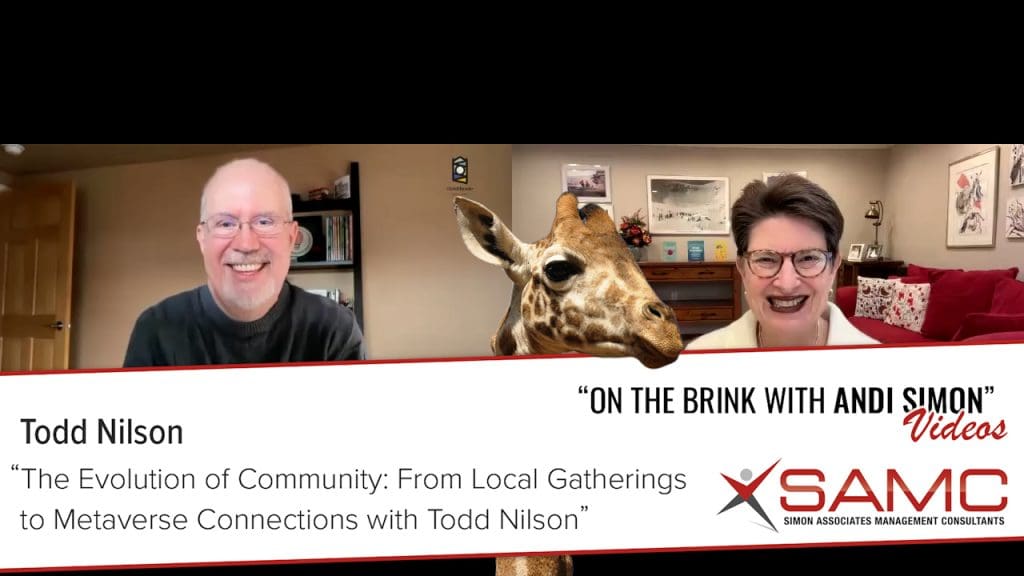
Humans need connection—not as a luxury, but as a foundation for thriving. Yet, in our hyper-connected world, loneliness persists. On this episode of On the Brink, I sat down with Todd Nilson, a community strategist with 25 years of experience in digital transformation and marketing for brands like Activision, Facebook, and SAP, to unpack what real community means and how to build it with intention.
Who is Todd Nilson?
Todd’s journey began in journalism, driven by an authentic curiosity about people and their stories. That passion evolved into a commitment to “building a bigger family”—creating spaces where trust and belonging are central. He’s clear: community isn’t a “soft” strategy; it’s essential for individual and organizational wellbeing.
We explored the difference between networks and communities. Social platforms may connect thousands, but true communities are intimate, purposeful, and safe. As Todd put it, a network is like a busy freeway—you can make friends, but it’s not where you belong. Real communities are built in “cozy warrens”: discussion forums, private groups, and member spaces that foster trust and meaningful exchange.
The technology for online communities is abundant, but Todd warns: tools alone don’t build belonging. Trust is foundational. He outlined three layers of safety—trustworthy platforms, credible conveners, and benevolent members—enabling honest sharing and engagement. He shared the example of Truth Initiative, whose online community helps people quit smoking and vaping. There, anonymity and trust turn participation into a true “return on life.”
Watch Todd Nilson on Youtube
Understanding Community in a Time of AI
Organizations and associations often struggle to sustain engagement beyond annual events. Todd believes communities should keep people connected to their mission year-round, deepen commitment, and serve as pipelines for volunteers or future staff. However, he cautions against focusing solely on technology while neglecting the ongoing stewardship that makes communities thrive. People—not platforms—build lasting connections.
Community success is a program, not a project. You can’t just launch a platform and expect results. Todd stresses the importance of having a dedicated human facilitator—more concierge than manager—who welcomes, connects, and guides members. While AI can help with moderation, it can’t replace human warmth or judgment.
We also discussed the importance of strategic clarity: before asking for proof of ROI, organizations must define their community’s purpose. What are the desired outcomes—reduced costs, improved retention, innovation? Community design must align with both organizational goals and member needs, even when those priorities differ.
Hybrid models work best. Online and offline communities reinforce each other, extending the sense of belonging and engagement. Tools like the Sense of Community Index 2 can help organizations measure how well their community fosters connection and contribution.
Culturally, we’re faced with an “always open buffet” of groups, but meaningful community requires intentional participation, not just passive consumption. We must choose where to invest our attention, seeking out spaces that truly feed us personally and professionally.
Big Ideas for Fast-Changing Times
Todd left us with two takeaways: First, plan for purpose—define who your community is for, why it exists, and the unique value it offers. Second, embrace emergent design—start small, let the community evolve, and focus on trust and gradual growth rather than a massive launch.
Ultimately, community is a driver of wellbeing—crucial not only at work but also in life’s transitions, such as retirement. Whether you’re building community for your organization or your next chapter, remember: networks aren’t belonging, and community doesn’t happen by accident. Purpose, trust, and stewardship make it real. Thanks for tuning in, and thank you to Todd Nelson for sharing such valuable insights.
Want to keep the conversation going? Learn more about Todd Nelson’s work in community strategy, and let us know what community means to you.
Todd’s Profile
Websites
- clocktoweradvisors.com (Company)
- talentled.co/ (Company)
- communityconsultants.life/ (Company)
Connect with me:
Watch for our new book, Rethink Retirement: It’s Not The End–It’s the Beginning of What’s Next. Due out Spring 2026.
Listen + Subscribe:
Available wherever you get your podcasts—Apple, Spotify, Stitcher, YouTube, and more. If you enjoyed this episode, leave a review and share with someone navigating their own leadership journey.
From Observation to Innovation,
CEO | Corporate Anthropologist | Author
Simonassociates.net
Info@simonassociates.net
@simonandi
LinkedIn
Here is the complete text of our podcast:
Andi Simon 00:00:02 Welcome to On the Brink with Andy Simon. I’m smiling because I have such a wonderful guest with us today. Who’s going to help you think about your community and the world that you’re in in fast changing times. Now, remember, I’m a corporate anthropologist. My job is to help you and your organization change. Actually adapt. You have to be agile and innovative. When times are changing, you can resist, or you can find opportunities of all kinds that are awaiting you. If only you can open your mind. So our podcast is designed to help you do just that. Todd Nelson is our guest today on his bio. It says community strategist. So guess what we’re going to talk about. Let me give you, his bio. And then he’ll tell you about his own journey because it’s a pretty cool one. So Todd is an executive and community strategist with over 25 years of leadership experience. He has honed his expertise in online community building, digital workplace transformation and marketing strategy. His additional background in competitive intelligence research, game thinking, recruitment, employer branding, virtual collaboration what a cool background he’s got.
Andi Simon 00:01:15 It’s been instrumental in delivering transformational technology workshops and strategies for top tier brands Activision, Facebook, SAP. And it’s very cool because his track record of success and community strategy makes him a sought after consultant for businesses looking to enhance the digital presence and build strong communities around their brand. Now, Mark Shafer, one of my favorite marketers, has a book about it’s all about the personal brand. It’s about community building. And I think that we’ve lost the fact that humans need people and they aren’t incidental. And the hardest thing to be is alone and lonely because your physical health goes down, your inflammation goes up and you need people. So today we’re going to talk about how we do that. Todd thanks for joining me today.
Todd Nelson 00:02:05 I was honored to be invited. Thank you so much, Andy. Great to spend some time with you today.
Andi Simon 00:02:10 Share with our audiences, viewers and listeners. Who is Todd? What’s your journey been like? Because I think I can read that, but I can capture the nuances and the softness of it.
Andi Simon 00:02:20 Please tell us your story.
Todd Nelson 00:02:22 Well, where to begin? I think, what led me to the to the world of community building, came out of a love for an interest in people and their stories. And you know what makes them tick? I had my original, undergraduate training as a journalist. I’d like to talk about myself as the last of the print journalists that were out there. I, I like nothing better than to sit down for an hour and have a conversation like this one where I get to know the other person. Or I understand, like the things that they care about, the things they want to do. So that I can maybe connect them with someone else that has similar interests. For me, it’s always been about building a bigger family, a bigger, a bigger group of people that that have that sense of connection and belonging to each other. And, you know, I think, as you said, this is something that we desperately need today. It’s that ability to build bridges of trust between each other.
Todd Nelson 00:03:28 And I agree with you. I think it’s something innate in our, in our DNA that that need to socially connect with other people is how we’ve evolved. It’s how we, you know, we came out of the caves and, you know, with our families and we found that other families and those families became tribes and those tribes became villages and, you know, and, you know, here we are today in a, in a modern world where we maybe feel a little more separate than is healthy for us. and so, so my work has, has always been about, you know, trying to convene groups that have common interests, you know, find ways for people to work with each other to create joyful new things and to, you know, maybe solve a, you know, solve a big problem, address a cause, you know, get better because of a, you know, a health concern, or even, like, just produce better work. these are all the functions of community that I think are so essential for a healthy, functioning society.
Andi Simon 00:04:33 do you have your own community that you are part of that really reinforces this philosophy and morality and ethics that you’re talking about, that you can describe in some way? Because as I was thinking about our conversation today, this is really an interesting time to even think about our own On community. I’ll give you a reason why it’s Thanksgiving time and I always like to have. When I’m not having Thanksgiving at my home, I have a Friendsgiving, and we’ll be doing that because it’s wonderful to bring in our friends from the local area, many of whom do not have any Thanksgiving family. And so, you know, we have 20 people coming to our cousins, but they don’t. And Friendsgiving to me is a wonderful way of celebrating our community. How about yourself?
Todd Nelson 00:05:25 So to that I would say, which community do you want to talk about? Because I think we all belong to many different kinds of communities. We have we have an embarrassment of riches if we only take advantage of them. And so I think a lot about, you know, my, my local community, which I live in, I live in a small town, Two Rivers, Wisconsin, on the shores of Lake Michigan, where I’m an active member of my business association, which is one community.
Todd Nelson 00:05:53 I’m a Rotary Club member, which is another community. I am active on the tourism board, which, you know, engages with the broader community of people who care about tourism and bringing, you know, people into the area. But, you know, my, my, my community work, has always had a digital component to it. And so, like, you know, professionally how I’ve developed and, and the initial excitement that I felt about the internet and, you know, from the early days, has always been that potential to connect with people that I might not have otherwise ever met, like you. And the joy of that ability to connect with people in online spaces is so incredibly important. So you ask, like what my communities are, there are many. me, my primary online community right now is one that is very dedicated to my profession. Community. Strategy. Community. Building online communities. There’s an entire profession of us out there. Although we don’t have good PR, but there are literally tens of thousands of community professionals, community managers who work in companies and enterprises in non-profit organizations to help gather people together, help them feel that sense of connection and belonging to each other and to, you know, manage not just the technology, but more importantly, the people connections, you know, that are there.
Todd Nelson 00:07:23 And so my community right now is, even more niche than that. I run help run a, an organization called the Community Consultants Collective, which is dedicated to people like me who are solo entrepreneurs who provide community consulting for other organizations. And there’s about 200 of us that are that are in that group, not a huge group. But as you might recognize that number being close to the Dunbar number. It’s a nice little village of people who all pretty much know each other. We’ve had pretty strong ties to each other.
Andi Simon 00:07:57 This is so much fun. Now here’s the interesting part. As you were talking, I thought about people and community as a as real us. You know, we can touch each other. you’re talking about virtual. And I never really went that way, but I have several virtual communities where I’ve never met the people. But once a month we get together and we don’t even have agendas for our conversation sometimes. it’s not tactical and practical. It’s. It’s wandering through things that are important to us.
Andi Simon 00:08:31 And I love your collection of people in the community strategist zone who could be, just building on each other’s wisdom. because in the absence of that, you’re solos, and that’s lonely.
Todd Nelson 00:08:46 Exactly. Exactly. And so, so I, I, I think that there’s such an opportunity to build better bridges using technology tools. It saddens me that, that that so many, so many, so many people, when they think of the online spaces, they’re just thinking about the big social networks and big. And I draw distinction. Big social networks are not communities. Those are their network spaces. There are places for broadcasting your services, being seen putting up cool stuff for entertainment. but they’re not wonderful places for a sense of belonging. And I know some people want to pick a fistfight with me about that. because, because they said, well, I’m on LinkedIn and I feel like that’s my community and I feel a sense of belonging and community there. Yes, sure. Wonderfully. I can also make friends in the middle of a freeway, but it’s maybe not the best place, you know to create that, that sense of belonging.
Todd Nelson 00:09:47 so I, you know, the, the, the, the strong, the stronger case for online spaces to have those sets of connections are. I almost call them the safer, cozier warrens of the internet, discussion forums, private WhatsApp groups. you know, maybe it’s a Facebook group, but, you know, you can’t trust that Facebook’s going to have that space there tomorrow. but there are. in my last estimate, there are over 130 online community platforms, that are out there as potential spaces where people could connect with their tribe and feel that sense of belonging with each other. And we have such a tremendous opportunity to build these things. You can create them for free. Now, the tools are such that you can have video calls and have, you know, groups of people meeting meet each other, as you said, and feel that sense of warmth and connection, you know, with each other and. Let me just interrupt myself there and say, you know, I’m not a care bearer about this stuff.
Todd Nelson 00:10:50 Like, I, you know. Yes. Warmth, the connection is important, but there’s something essentially human and necessary about these spaces. It is it’s desperate. Like, if I was a Care Bear, it’d be a care bear with a switchblade on his, you know, on his stomach. Because, like, this is this is deadly serious stuff. And I think that, like, as you alluded to in the beginning, I think you’re maybe referencing the surgeon general, the Surgeon General’s report around the loneliness epidemic that we have in that sense of disconnection that that we’re suffering from, that goes and alludes to things like Robert Putnam’s research in Bowling Alone and his subsequent books, where we’ve sort of lost that sense of connection and civic identity, you know, very specifically here in the US. But I think it’s a worldwide problem.
Andi Simon 00:11:39 Let me ask you, then questions in sequence, which I don’t usually do, but I want to make sure we don’t forget about them. so let’s change.
Andi Simon 00:11:49 Let’s talk about I have 14,000 connections on LinkedIn. I don’t know any of them, but that’s my, my network. I mean, LinkedIn is a platform that 150 platforms. That’s a really interesting one. what does that convert into? my second question is community. What would a community look like, feel like? But, you know, I meet with some wonderful thought leaders, women, thought leaders once a month. I feel more like a community. It’s a small group, but it is much more intimate than my 14,000 friends on LinkedIn. And so you have a network, you have a smaller, intimate 200 people group, right? And then then you have, this kind of weird in person, thing. That used to be the only way. And now it’s one of many ways. So how do we blend that together? There’s one more. And that is the community, that, metaverse, where people are playing games with total strangers but are deeply involved with their, avatar. I mean, they buy diamonds for the woman they fall in love with online and they don’t know them from at all.
Andi Simon 00:13:05 But it’s an evening exercise in community and it’s a huge community. So help me the network versus the community, the small versus the large in the remote, game playing communities that are emerging, you know, describe them a little bit from your perspective. And how can we help our listeners and me that?
Todd Nelson 00:13:27 Sure, sure. Keep me on track because I, you know, you ask me three things and I you know.
Multiple Speakers 00:13:31 I know, I know, I know, that’s why I.
Andi Simon 00:13:32 Normally don’t, but I like at least to set up the stage for us because I think they’re important. Please, I’ll keep.
Todd Nelson 00:13:36 On mind like a steel sieve. Things just kind of leak out of it all the time. then, the first one that you’re talking about, that that sense of you’ve got 14,000 connections on LinkedIn. And, like, is that your network? You don’t really know them that well. Those are, you know, I think people talk about sort of like their strong connections versus their weak tie connections.
Todd Nelson 00:13:59 you know, the LinkedIn is wonderful as just sort of a, a social graph of the people that you may know of and some people that you may know a little better. it’s an interconnected web of people that you’re, you’re connecting with, but you don’t necessarily share the same values with those individuals you don’t have. You don’t share the same professional concerns. You may help each other. You may have a connection there that you talk to on a regular basis. And you like them and their friends. but that’s a that’s a network. when, when it becomes more of a community. Immunity, that that implies some sense of purpose around the gathering beyond. Just like I’m joining the party that never ends. Like, I it’s got to be something that has, some end in mind. some, you know, you’re trying to change the world. You’re trying to further your professional whatever your, your professional practice area happens to be your, your meeting with your, your entrepreneurial startup to get, get work done.
Todd Nelson 00:15:07 You are a belief group. Like you’re a group of online Zen Buddhists, or you’re a, a group of women firefighters, national and national group, you know, getting together to talk about the concerns of, you know, being a firefighter and being a mother, you know, to or whatever. Those, you know, those situations mean, like there’s usually one or more reasons that, you know, for, for you to come together. And I and I think the task between sort of like a big social network and an online community. Space tends to be something like if you are posting in a social network, there are two things that can happen. One is you post something in; the algorithm loses it; it just goes away. It’s gone. and the other is that you post something, and some internet trolls find you and they decide to just mock you and make fun of everything you’re going to do. Both of these things are not conducive to community building. They are endemic with broad networks where anybody can kind of jump in, and there’s so much activity in the big social networks that they have to have an algorithm to kind of show you the things that the algorithm thinks you want to see, so that you stay on the platform longer and monetize the platform like that’s the interest that’s causing.
Andi Simon 00:16:24 So my algorithm is my buddy.
Todd Nelson 00:16:26 Right. Right. So the online community, however like the community platforms that are there tend to be based on, like some levels of safety, some three, three levels of safety. First of all, is the platform doesn’t seem sketchy. It seems like a modern experience, even if it’s a little janky. It just seems it feels like it’s trustworthy enough, you know, to use second level. Who’s convening this space for me? What’s the company? Have they been transparent about what they want out of it? Why are they. Why are you doing this for me? You got to give me some kind of justification. And third of all, there needs to be a level of a trust in the benevolence of the others in that space. And so, in other words, you’re going to post something, and you feel that. You feel that the others there are sympathetic or empathetic enough to what you’re talking about, that they’re not going to troll you, that they are actually coming from at least a similar space, and that they’re going to want to be able to have a quality discussion about this topic.
Todd Nelson 00:17:25 Not to say that a quality discussion can’t happen on a social network, but it’s more likely that more in-depth discussions, more vulnerable discussions, more revealing discussions will happen in a true online community space than not. And so those are the distinctions, you know, for me, about the way that they work. And what is nice about an online community is that it is a place that you want to return to again and again. There’s a sense of safety, there’s a sense of belonging, of shared values and of being able to get it. Better information, better insights, better opportunities to grow and change than you’re going to get in, like the big online parties that are out there now.
Andi Simon 00:18:07 So we talked about the network, which is almost like a directory of people who at least recognize you in some way, LinkedIn. and then there’s a community like my once a month group of women thought leaders that started during the pandemic. And while we’ve shrunk a number, we’ve added some new and we trust each other to raise some important questions sometimes Not always nice ones, but sometimes, you know, really important.
Andi Simon 00:18:33 I got to raise this. We got to deal with it in some way and trust that the conversation won’t push people away, but they’ll keep coming back from work. And those who come really like to come. and then, there’s a real community I kept in the metaverse at the end. But, you know, when, when we, I’ve never met any of the people in my thought leaders then, and, and it becomes interesting because there are times when I have coached people and then I have met them in person, and I didn’t recognize them. They were different people in real person then. They were just different. and I belong to a women business collaborative organization, and once a month we have, some kind of a gathering. and different people come each time. So you’re never quite sure what we’re catching up on. but it is, but I’ve never met any of those, and we’re all working around the same thing of how to improve people in the women in the workplace. So this is it’s really cool.
Andi Simon 00:19:35 listening to you. Are there some that you’ve done that really were standouts? Have you done them for companies in some way? I mean, is this something that companies can realize benefit from? You know, I, I’m projecting onto what you’re saying, my own experiences, but I have a hunch the listener would love to know what has Todd found and how has he used this? Give me some ideas if that’s okay.
Todd Nelson 00:20:01 Sure. I mean, it, that’s it’s an entire our webinar, you know to talk about that. But I’ll, I’ll, I’ll boil it down as well as I can. yes. It’s absolutely valuable for companies to, to have these spaces. the only times when, when I’ve seen communities don’t work for large organizations is if there is not a level of trust between the people or between the organization. So like a, like an auction community where I’m competing against other people for products that I want. Unless you’re really careful about how you are setting the tone for that space, it’s not likely that there’s ever going to be any sense of connection or belonging, you know, in a group like that, because they’re not going to share their secrets about getting better deals or about getting it getting a low price.
Todd Nelson 00:20:55 They’re not going to share where they look for things. They’re not going to share how they search for things, like what are they going to share? You know, in the space, you know, same thing. Like anytime there’s money involved with stuff like that, that it muddies the waters around creating that sense of trust. Where it works really well is like health care, mental health, dealing with addiction. you know, the, the spaces for that are incredibly powerful and useful. I’m proud to say I’ve been working for the past couple of years and sexually, my second tour of duty with an organization called the Truth Initiative. It’s based on a DC, and they originally had the Big Tobacco settlement. they, they run the world’s largest online community to help people quit smoking and vaping and using nicotine products. Wow. It is incredibly powerful place to be because people can enter into that space within a non. They don’t have to use their real name. It’s anonymous screen names you know, to enter that space.
Todd Nelson 00:21:57 And they can share vulnerably like the things that they are going through emotionally physically. You know, day to day to try to overcome their cravings. for, for this highly addictive drug. And so, I’ve been really proud to be a part of that organization, because when you talk to the individuals who have joined that community Immunity and been able to quit for any appreciable amount of time with it. They will tell you I’m alive. Because of this community, I have literally like you want to talk about an ROI for me. Let’s talk about life. Return on life, right? Yeah.
Andi Simon 00:22:39 Now, this is so interesting. Do you find that associations are gravitating to this? Because I spoke last December, actually almost a year ago in Washington, and so many of the members of the group I was talking to were associations struggling with what’s our role in an age of AI? What role do we play? And their membership was diminishing. I’ve had a client in June that we were talking about, you know, how do we begin to understand what they need at a time when what we have always done doesn’t seem to be working very well, but, you know, are they are there particular I mean, this is what you mentioned is an association that adds mental health or value in that way.
Andi Simon 00:23:22 should all associations be thinking about an online virtual community as a way of adding some value? It sounds like an interesting possibility, and I’m because I have an association that I’m beginning to think about. it could be an interesting way of rethinking what they’re doing. Not in-person events, but online ones. What do you think?
Todd Nelson 00:23:42 Well, I think that many associations have done the calculus around that and have realized that, yes, they need an online component of community for their work. They already have a community of people that are interested in the mission, vision, values of what they’re trying to do, the change that they’re trying to affect in the world. But they soon realize that having an annual conference or occasional sporadic events throughout the year is not a way to sustain engagement in the vision for the organization. And so if they’re going to have a regular group of volunteers, of donors, of backers, of people that feel connected to the mission. Having an online community space where people can join when they have time to dip in their being reminded of things that are going on with that cause, it helps those who are, I’ll call them the superfans for the organization to really steep themselves, you know, in the mission of that that organization, they can they can live the mission and that becomes a possible avenue of recruitment for the association.
Todd Nelson 00:24:53 Like maybe our superfan becomes one of our one of our employees. it also becomes a way to amplify the voice and mission of the organization by empowering those individuals and by bringing in newcomers to help them see what the mission is. So they’re really, it’s a way to, duplicate or amplify culture, for that association and whatever they do. And so I think many, many associations see the value of that. I think where they sometimes struggle with it is and I’ll, I’ll expand this to all companies. And enterprises will sometimes struggle with the idea of being too focused on the technology and not enough on having a good strategy for engaging the people in the network. And so that’s the work that I love to do. Like, I’m as nerdy about the tech as anybody. I like looking at the different platforms and the things that they can do. But at the end of the day, if you’ve got a simple WhatsApp group or an email list that can actually convey a sense of community, you know, in and of itself, I think there’s a tendency to get too hung up on the technical requirements of this stuff and not put enough money into the actual operations of a successful community.
Andi Simon 00:26:11 So let’s talk a little bit about what would a successful operation of the community look like? because the tendency is to go through the. What do I do? And how do I do this as opposed to why should I come and how? Does it add value for me? and I think about the ones that are on my calendar. it’s monthly, you know, happy hours or a monthly, you know, retreats or whatever. and, and, you know, how can they enhance it so that I really do want to come as opposed to its on my calendar, I should come. are there lessons that you’ve learned wisdom to share? don’t forget about that you can offer. Because I think that your experience is so much bigger than mine. What would you suggest?
Todd Nelson 00:26:57 I mean, I think a couple of things. One is that these communities need to be thought about as a program and not a project. for any enterprise organization, it’s not like you can turn on your community platform, expect people to show up and be active little participants for you, like little pets in a zoo? You know it doesn’t work that way.
Todd Nelson 00:27:17 Humans. Humans aren’t wrapped in that kind of package. You need. You need at least someone who is going to be you. Your welcome here. Your facilitator, your evangelist. For that community. So, I, you know, the term that is usually applied to the community professionals, the community manager. I don’t like community manager as a as a job title manager, you know, implies hierarchy. It implies somebody that’s like keeping the lights on and sort of managing the things that don’t go off the rails. And I think the role is so much more than being the traffic cop or the person that’s, you know, beating away the spammers, you know, and the bad actors in the world, or resetting passwords. This is someone that has to believe in the mission of what’s there. And they are they are acting like, you know, the hotel concierge you go up to and say, like, where’s a great sushi place for us to go in this neighborhood? They know where you can go or hey, I’m, I’m looking for, you know, a great, musical act to go check out the night.
Todd Nelson 00:28:25 Oh, you know what you want to go see? You know, Indian, the crooners, you know, or whatever. Right. so, so, so, so having someone who has accountability for that role, and is managing that, that program on an ongoing basis is critical to success. You can’t and you can’t turn on to do it either. You might have an AI as a helper, as a sidekick in that work, you know, helping with moderation of topics and discussions or, you know, flagging things or helping you with, with metrics. You don’t want that thing as your as your community manager. It’s just it’s not it’s not warm. It lacks it lacks that, that that sheen of humanity. the other the other thing that’s really important to remember is the, because organizations are more complex beasts than just sort of starting up a local club. you know, for your, for your discussion group or, you know, a lunch or lunch group, you need to go through the process of, documenting, you know, what your plan is for that community.
Todd Nelson 00:29:32 So there needs to be discussions with all of the key stakeholders in your organization, expressing, you know, what business goals you’re trying to drive by setting up that space. Are you trying to reduce costs? Are you trying to deflect help desk tickets for your software? Are you trying to get more ideas to innovate your product or service? Are you trying to ensure that that more of your customers are making use more, making full use of your software so that they’re more loyal to the brand and that they continue to renew on a regular basis? These are all areas where community can have an impact, but you need the, the executive leadership team to express what they want for that. it’s nothing more frustrating for me than to hear from one of my community professional friends who were talking to a leader or CEO of their organization and says, well, you got to tell me what the ROI is of this community or I’m not going to fund it anymore. No. That’s your job as the CEO to say what kind of result you’re trying to drive.
Todd Nelson 00:30:36 And then that’s my job as the community professional to tell you how we’re going to help you get there with that work. So you need to have that articulation of that communication, not just with the leadership team, with any of the other stakeholder departments in an organization. And then you need to go out to the community members themselves and validate what they want, because what they want might be very different than what the corporate team wants. Overall.
Andi Simon 00:31:02 You know, I’m sitting here and of course, as you’re talking, I’m thinking about the organizations that Communities that I do belong to and the things that I enjoy and don’t enjoy. And it’s, you know, I can almost put it up on a whiteboard with them. These I go to because it’s necessary and these, I sort of dabble in and out of because I’m a member. So I paid my way. I should find out what’s going on. And these I love because I really like the people in there because I get something out of it. and the ones in the middle always have something like a game or an activity of some kind.
Andi Simon 00:31:36 And I’ve yet to figure out the purpose of it. And, and, and I get irritated at wasting my hour at things that seem trivializing it. and then the one that I really, really, really want to be good, needs to be doing things that are important. And I need to be there to know what they’re doing. Sometimes they don’t have an agenda, and sometimes I haven’t organized it. But this isn’t sort of easy. This is an important organizational system that has to your it’s not a project, it’s a purpose. And it’s got to have reason for people to keep coming. And each time they can’t be different people because then it loses its purpose, right? And so it becomes it’s interesting listening to I’m learning a lot about how I might help some of these that I belong to do a better job, at least so that I go willingly for delight. Now, do you do all also these things for communities, real people in real life?
Todd Nelson 00:32:33 I think inevitably the work is overlapping and complementary.
Todd Nelson 00:32:40 So, so many of the for profit organizations I’ve worked with have a live event component to what they do that is actually a feeder for their online community. Interesting. And so there’s a, there is a, a symbiotic relationship between the online and the offline, you know, kind of kinds of meetings that, that, that take place. They strengthen each other over time. certainly a lot of non-profits. They’ll have chapters or groups that get together. And then there’s sort of. A broader group that meets online. you know, there’s some work that I did years ago for Vista International that was set up like that, which was, of course, business networking pods. I don’t think they used that terminology, but accountability groups that would get together as executives to talk about their work, but then their online space was multiple, you know, all of those together. And then it was all about the cross pollination, colonization of those different groups together and finding strength in it. So hybrid is one of my favorite ways to look at community, because I, you know, the principles are the same.
Todd Nelson 00:33:48 there’s a there’s a validated survey. It’s been around for many years. It’s called the Sense of Community Index two. that’s like a I think it’s a 28 question instrument that can be applied to live communities or online communities. It’s been equally validated and it asks questions like, when I joined this space, I feel like I can contribute. When I join, I feel a sense of belonging with others here, and it’s asking people to rate that and sort of based on what you get. You can get a sense of the health of that community or its own sense of itself.
Andi Simon 00:34:24 When we’re done. If you could send that along, I’ll put it into the blog post, because I do think that would be very interesting to think about. The viewer may want to think about it, but I’m thinking about my own groups, and you know time spent is important as well as engagement. We started out by talking about the fact that people shouldn’t be lonely. The question is, can these online communities play a role in building a community, not just a network of individuals, and can add value innovatively to each other’s lives? not just for business, but for being part of something.
Andi Simon 00:35:04 I have a hunch a community strategist with 200 folks work well to keep each other, you know, informed about what’s going on and, and how to do better at what they’re doing. So I made a whole lot of notes as we’ve been talking, one of which is around as an anthropologist, I am fascinated by the human culture, and that’s how we probably outsmarted the Neanderthals. was with the stories that we tell and how we’re doing it. do you see this as a major cultural transformation that’s come along? the technology’s allowed it. and some are working probably. Well, and others are trying to figure out how to do well. but. And are they serving a real. I think they’re serving a real interesting role. Not always completely what you want, but interesting and different. So from an anthropological perspective, I have a hunch you might have some wisdom to share. And then we’ll do our wrap up.
Todd Nelson 00:36:00 Yeah. You know, it’s an endlessly fascinating question for me. And I think that, the, the as usual, the technology outpaces our maturity or literacy level, in working with it.
Todd Nelson 00:36:17 And so we find that, yes, there are technologies that support our ability to gather with others in online spaces and connect. but I think the thing that we’re coming to terms with now is there’s such an overwhelming number of things you can do. It’s like the it’s all you can eat buffet, and the buffet is never closed. And so the danger with these online community spaces is you can join hundreds of communities, anything that looks interesting to you, you can join, you can go on to 15, 20, 50, 100, a thousand communities.
Andi Simon 00:36:56 I’m laughing because you said.
Todd Nelson 00:36:58 You can and you and you can drop into those spaces. Like how many slack instances do you have? you know, each one of those could be thought about as its own, you know, little individual community ecosystem. but then then you need to think about, like, from a maturity level, how much time do I actually have to spend in these spaces? it’s one of my, it’s one of my occupational hazards that I get invited to everybody’s community, and I’m very interested in that from an academic perspective, because I can see.
Todd Nelson 00:37:28 Okay, well, this is working. This is this is how onboarding works. This is this is how they’re getting people engaged right away. This is how people, you know, stay engaged long term with, like, I’m interested in that. But in terms of my own ability to participate, I’ve got to, you know, take a step back and think about like where I’m actually fed. you know, in those spaces. And I think this is the maturity level that we’re maybe going to get to, I think I’m seeing some signs of this with like the lessening use of social media, and people craving more direct connection, like more in person, groups to belong to as well as, I think some of these more private community spaces. There’s that craving for connection that we want, and it’s not being fulfilled by some of these larger spaces. But at the same time, we need to develop that inner maturity to understand if I’m going to join a community, I should be joining it intentionally with the intention of participating in meaningful ways, because that’s the only way I’m going to get fulfillment out of that work.
Andi Simon 00:38:38 You’re reminding me of one group on discord, that had, you know, like a three month trial, and then there was a fee to stay. And I thought about it a lot, but I found it as a, as a platform under whelming for myself. And the conversations, while interesting, were difficult to stay engaged in. And I just said thanks, but no thanks. I really was happy to test it, but not there. But you know, and there’s so many, Substack stuff that has come out that I like to watch the, the stuff flowing, but I don’t feel like paying to play. And there’s sort of this, this kind of how far in do I want to go. And then the ones that I belong to, I’m thinking about carefully about, you know, what is it about them that adds value to my exist in my life? not just my profession, but my personally and give me pleasure. very insightful conversation. I’m having such fun. But we do need to wrap up.
Andi Simon 00:39:36 And I often ask my guest a couple of things you don’t want the listener to forget, because remember, we’re getting them off the brink. Our job is to help them see, feel and think in new ways, which you have done. You’ve done for me 1 or 2 things that you would like them to remember. Todd, other than Todd Nelson as a way of building community strategies. Give us some thoughts to end us.
Todd Nelson 00:39:59 First and foremost, plan. Plan for purpose in the community. I think that if you if you create a community that’s got to stand for something, you need to be clear about communicating what that value is, why someone would want to join who it’s for. Don’t plan it for a generalized audience. You need to really be razor focused. Laser, laser focused. Laser, laser focused. incredibly important. Now where there are all of these, you know, potential spaces that you can join if, if, if, if you’re painting in beige, you’re going to get missed.
Andi Simon 00:40:36 Well, but that’s really important for both corporations’ associations and just people. you know, nobody put these women thought leader group together but us. And it came out of a group someone else put together that we didn’t find gratifying. So we said let’s. Let’s keep it going with just us and it is shrunk. But we’re adding in. It doesn’t matter if there are three of us or two of us or ten of us. and I like your 200. I’m not sure what I would do with them all, but it is. It is a real cool time. So please.
Todd Nelson 00:41:09 And then one other item before we go is to don’t plan for the big launch, plan for emergent design in what you do. You know, it’s the old saying, like, Rome wasn’t built in a day. Neither was your online community. planned for, successive small and then larger releases. to your members, find that core group of 5 to 15 people that are a real good fit. Like they get the mission of what you’re trying to do.
Todd Nelson 00:41:39 They are on board. They’re going to be really willing and enthusiastic about what you’re going to do, and then have them invite their friends in. And so like that, where a lot of large enterprises mess up and you can’t tell them this. They don’t want to hear it, but they want to just launch all their customers at once. And that’s not a way to create a sense of exclusivity where, you know, hey, those cool kids got invited. Why didn’t I get invited? Well, you know what? You will eventually get invited, you know, to the space. But we want to prove out the concept of the community first. Like, there will be mistakes that you will make. Like, communities are not generally born flawless. In fact.
Andi Simon 00:42:19 Anything but you know, the I am. I mean, completely intrigued. Fascinated by what you have discussed today. And I can’t tell you how much I pleased it. I’m pleased with it. I we did not talk about the metaverse and the communities that are built there.
Andi Simon 00:42:35 That’s a whole other conversation. We can come back to it, because I do think that that is huge. And the way in which people are living in those metaverse communities is a whole other human culture. well beyond I mean, they’re playing the games that the others are trying to create so that when you come, there’s something to do instead. The online games are all about doing. And then we have your avatars, and it’s just an interesting time for humans to be human. I’m. I’m delighted. Thank you. Todd. This has been great. So let me say goodbye to everybody. remember, my job is to help you see, feel and think in new ways. On the brink is here to get you off the brink. And if you haven’t, like, I haven’t been thinking about these online communities or your Thanksgiving folks who are coming, who are your Friendsgiving? That’s a good time to remember. Humans need people, and people need each other, and they need to have shared ideas about what they like to talk about and enjoy and be part of, because that’s being human.
Andi Simon 00:43:40 And our culture is all about the stories that we share. And I will tell you that for these associations and others, it’s all about the stories that you’re bringing. Your agenda matters. You know, what is it we’re meeting about and why does it matter this time? And why should we all get together to talk about it? What’s hot? What’s not? My books are all on Amazon. Look for Andy Simon. I’m there with On the Brink, which was the genesis of this podcast. Rethink smashing the myths of Women in Business and Women mean business. My new book is coming out in the spring of 2026. It’s called Rethink Retirement, and it’s all about how all the people I interviewed are beginning to rethink, oh my God, what did I do here? And how come I didn’t plan better? And I will tell you, a little loneliness isn’t so good when you retire. You need to have others to share. Community is really the driver of happiness when you are in work or after.
Andi Simon 00:44:35 Anyway, remember take your observations. Turn them into innovations. The time is ripe for you and I will say goodbye. Thank you, Todd. Thank you for coming. It’s been a pleasure.
Todd Nelson 00:44:45 Thank you. Andy.